
Patentability Search: Mother–Newborn Matching Algorithm
Case Study

Could Existing Patient-Matching Algorithms Undermine a Patent on Mother–Newborn Identification?

A targeted patentability investigation connected weighted patient-record matching, maternal–newborn identification and threshold-based scoring to assess whether the claimed algorithm represented a distinct technical advance.

Case Study Type Patentability Search
Industry Healthcare
Publication Date November 18, 2026
mother and newborn image

The Client’s Challenge

The client sought to assess the patentability of an algorithm designed to match maternal and newborn records using personal information and weighted scoring.

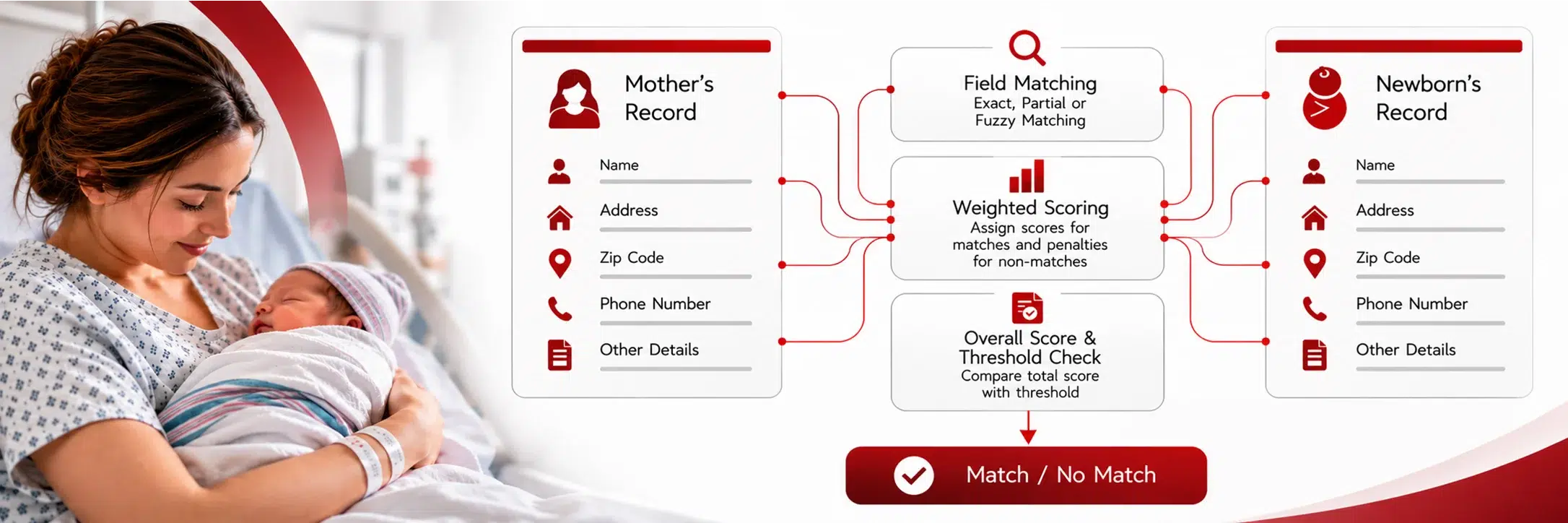
The patent examined in this investigation described a mother–newborn matching algorithm built around discrete personal-information fields, weighted comparisons, penalties for unmatched information, aggregation of matching scores, and a threshold-based quality assessment. The central patentability question was whether this combination represented a distinct technical contribution or an application of existing record-linkage techniques to a specific healthcare use case.
Mother and new born match image

The patent claims primarily covered:

    • Organization of maternal and newborn personal information into discrete matching fields.
    • Assignment of weights for exact, partial, or fuzzy data matching.
    • Penalization of unmatched personal-information fields.
    • Aggregation of matched and unmatched weights into an overall score.
    • Comparison of the overall score against a threshold to assess matching quality.
Objective icon
CLIENT’S OBJECTIVE

Assess the patentability of the claimed mother–newborn matching algorithm by identifying prior art relevant to its novelty and non-obviousness.

The investigation focused on identifying prior art covering the weighted matching of personal information, aggregation of matching and unmatched scores and threshold-based quality assessment.

Clients come to us for answers.
They leave with opportunities they didn’t know existed.

Our experts help organizations uncover insights, opportunities and strategic directions that traditional approaches often miss.

Wissen’s Out-of-the-Box Approach:

Expanding Prior-Art Search Beyond Mother–Newborn Matching

  • Recognizing the limitations of conventional keyword-based searching, the investigation evolved beyond references explicitly describing mother–newborn identification to examine the underlying computational mechanisms used in healthcare record matching.
  • To develop a broader and more technically grounded assessment of patentability, the investigation expanded to include prior-art disclosures relating to:
  • Weighted patient-record matching
  • Maternal–newborn record matching
  • Score aggregation and threshold assessment

Identifying Relevant Prior Art

  • A refined search strategy was developed by expanding technical terminology, incorporating relevant patent classifications and broadening coverage across international patent literature and non-patent publications.

  • The investigation identified three potentially relevant references. Although these references addressed different aspects of the claimed invention, their combined teachings provided a basis for evaluating whether the proposed algorithm represented a distinct technical contribution or an extension of existing record-matching techniques.

Our Methodology

Traditional Search Limitations
Refined Prior-Art Search
Identification of Relevant Prior Art
Claim-Level Feature Mapping
Cross-Reference Analysis
Patentability Assessment
Traditional Search Limitations
  • Limited keyword search results
  • Incomplete algorithmic disclosures
  • Fragmented technical evidence
  • Gaps in claim coverage
Refined Prior-Art Search
  • Expand matching-related keywords
  • Integrate relevant patent classifications
  • Search international patent literature
  • Examine inventor-related work
Identification of Relevant Prior Art
  • Identify weighted record-matching methods
  • Locate maternal–newborn matching disclosures
  • Examine scoring and threshold mechanisms
Claim-Level Feature Mapping
  • Map references against claim elements
  • Analyze matching weights and penalties
  • Evaluate aggregate scoring and thresholds
Cross-Reference Analysis
  • Compare complementary technical disclosures
  • Identify gaps in individual references
  • Assess potential obviousness arguments
Patentability Assessment
  • Evaluate novelty and non-obviousness
  • Identify potentially anticipated or obvious features
  • Document evidence-based findings
Outcome:

Identification of three complementary prior-art references addressing weighted record matching, maternal–newborn identification and threshold-based scoring to support patentability assessment.

Prior-Art Search Methodology

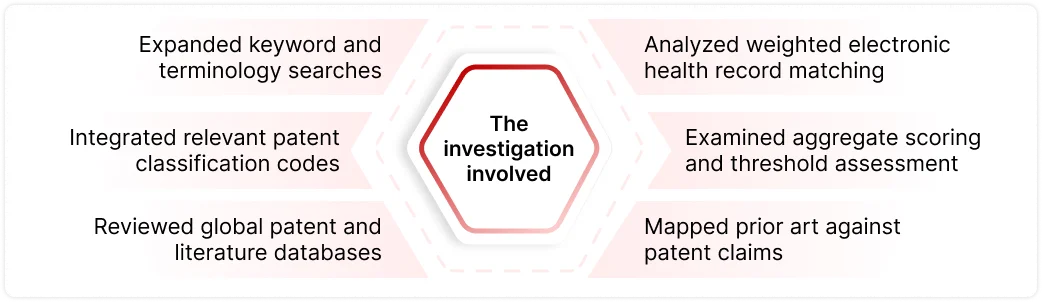
The investigation involved a structured patent and non-patent literature search to identify disclosures relevant to the mother–newborn matching algorithm and its underlying weighted scoring mechanism.

Mother and newborn match case study methodology

The refined investigation identified prior-art references addressing weighted electronic health record matching, algorithmic matching of maternal and newborn information and aggregate scoring with threshold-based assessment.

These findings provided a structured basis for evaluating the claimed algorithm against existing technical disclosures and assessing potential novelty and obviousness challenges.

Technical Challenges Addressed Through Prior-Art Analysis

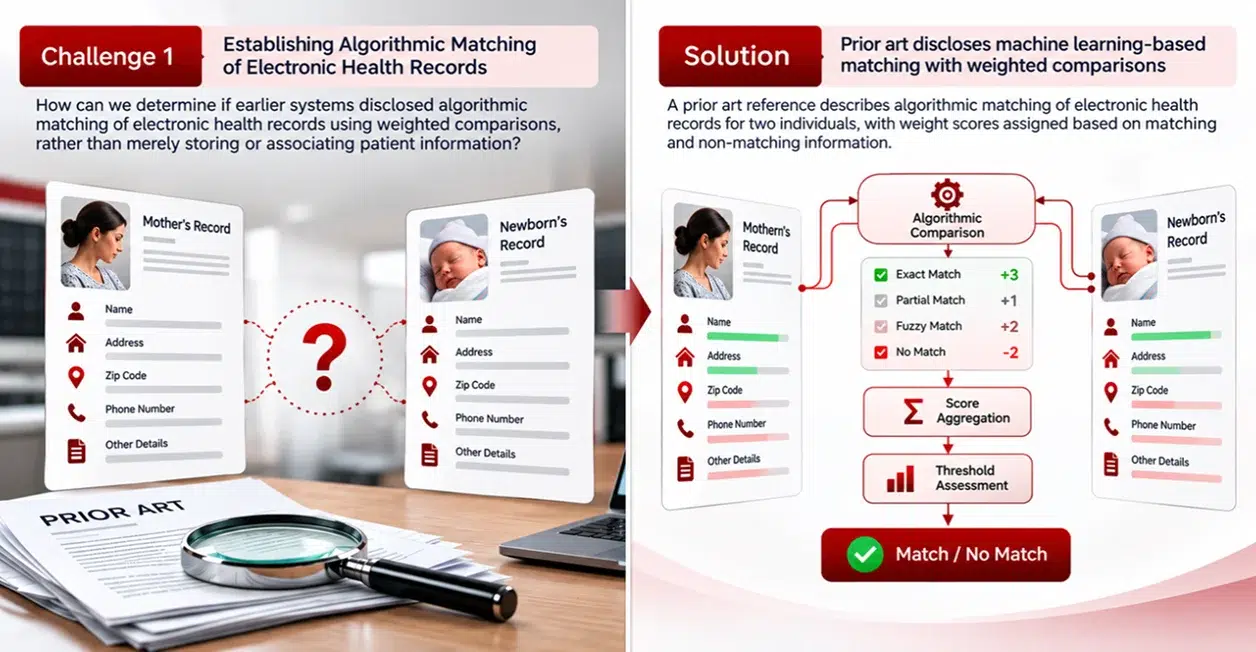
Challenge 1: Establishing Algorithmic Matching of Electronic Health Records

One of the key challenges involved determining whether earlier systems disclosed algorithmic matching of electronic health records using weighted comparisons, rather than merely storing or associating patient information.

Solution

The investigation identified a US patent describing machine-learning-based matching of electronic health records belonging to two individuals, with weight scores assigned according to matching and non-matching information.

The analysis revealed:
  • Weighted matching of electronic health records
  • Algorithmic comparison of patient information
  • Score adjustments based on matching and non-matching fields

These findings provided relevant evidence that weighted patient-record matching mechanisms had been disclosed in prior art, establishing a technical basis for assessing the corresponding features of the subject patent.

newborn challenge
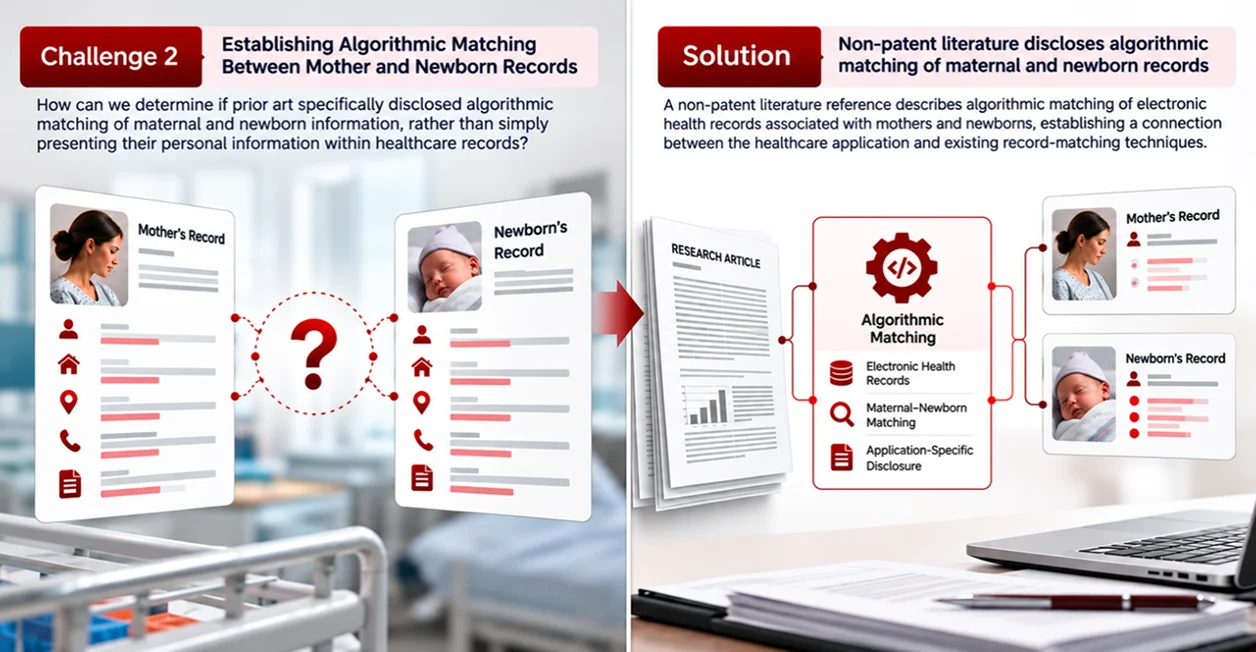
Challenge 2: Establishing Algorithmic Matching Between Mother and Newborn Records

Another important challenge involved determining whether prior art specifically disclosed algorithmic matching of maternal and newborn information, rather than simply presenting their personal information within healthcare records.

Solution

The investigation identified non-patent literature describing algorithmic matching of electronic health records associated with mothers and newborns. This disclosure established a connection between the claimed healthcare application and existing record-matching techniques, although it did not reportedly disclose the complete weighted-score aggregation mechanism.

The analysis revealed:
  • Algorithmic matching of maternal and newborn information
  • Use of electronic health records for matching
  • Application-specific disclosures relevant to mother–newborn identification

These findings helped establish the relevance of earlier healthcare record-matching approaches to the subject patent while identifying the scoring mechanism as an area requiring further prior-art assessment.

Mother and newborn match challenge

Results & Business Impact

The investigation successfully identified complementary prior-art references addressing weighted patient-record matching, algorithmic matching of maternal and newborn information and threshold-based scoring. Together, these disclosures provided a structured basis for assessing the patentability of the claimed algorithm.

Key Outcomes

  • Key outcome Icon

    Identification of relevant prior art covering weighted electronic health record matching.

  • Key outcome Icon

    Discovery of technical literature addressing algorithmic matching of maternal and newborn records.

  • Key outcome Icon

    Identification of prior art disclosing aggregate matching scores and threshold-based quality assessment.

  • Key outcome Icon

    Establishment of a feature-level basis for evaluating the claimed algorithm against existing technical disclosures.

  • Key outcome Icon

    Strengthened support for an obviousness-based patentability challenge through complementary prior-art analysis.

Strategic Business Impact

By expanding beyond conventional keyword searches and examining the underlying computational mechanisms, the investigation provided:

  • Broader prior-art coverage across healthcare data-matching technologies.
  • Improved assessment of the distinctiveness of the claimed algorithm.
  • Stronger technical foundations for patentability and obviousness analysis.
  • Reduced risk of overlooking relevant disclosures outside the immediate application domain.
  • More informed IP strategy through structured comparison of existing technical approaches.

The approach demonstrated how combining patent literature, non-patent research and feature-level analysis can reveal relationships between existing technologies that may not be apparent through narrowly focused searches alone.

Need to Assess the Patentability of a Complex Algorithm?

Our team supports organizations in examining complex technical claims through targeted patent searches, non-patent literature analysis and feature-level prior-art assessment.