Who Invented This? The AI Question That Could Redefine Intellectual Property
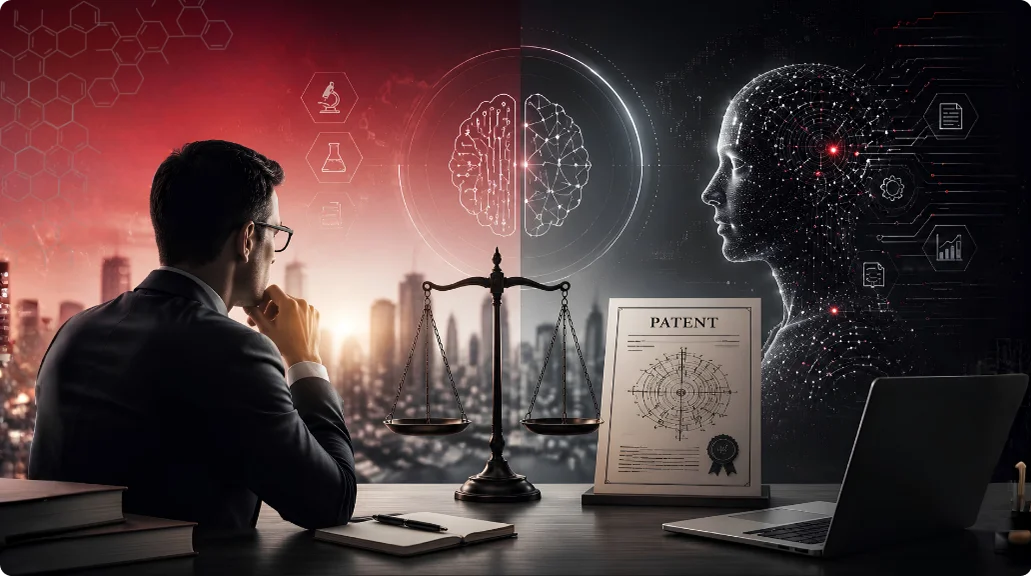
Every patent application begins with a question that appears deceptively simple: Who is the inventor?
For more than a century, patent systems across the world have operated on an assumption so fundamental that it has rarely been questioned: the inventor is human.
A scientist discovers a new chemical compound.
An engineer develops a novel mechanism.
A researcher creates a technical solution to an unsolved problem.
The inventive act may be complex, but the source of that act has traditionally been clear.
Until now.
Consider a future scenario.
A pharmaceutical company uses an artificial intelligence system to explore billions of molecular combinations. After analysing patterns invisible to conventional research methods, the system identifies a molecular structure with promising therapeutic potential. Scientists validate the discovery. Experiments confirm its properties. A patent application is prepared.
The invention exists.
The commercial opportunity exists.
But one question remains: Who invented it?
This question represents one of the most significant conceptual challenges facing intellectual property today. The deeper question is whether concepts developed in an era of purely human creativity remain sufficient in an age where computational systems can increasingly participate in discovery.
The Patent System Was Built Around a Human Assumption
Modern patent systems were designed around a relatively straightforward model of innovation.
A person identifies a technical problem.
That person develops a solution.
The solution demonstrates novelty and inventive contribution.
The inventor receives recognition and the right to seek protection.
This model reflects more than administrative convenience. Inventorship carries legal and philosophical significance.
It establishes:
Historically, invention was closely associated with human qualities:
Patent systems did not need to define whether a machine could invent because, for most of modern history, machines did not appear capable of producing novel technical concepts independently.
Artificial intelligence changes this assumption.
From Human Creativity to Computational Discovery
Innovation has always relied on tools. However, artificial intelligence introduces a different type of capability. Modern AI systems are increasingly able to:
The distinction is important.
Traditional tools generally expanded human capability. AI systems increasingly influence the direction of discovery itself.
In sectors such as pharmaceuticals, semiconductor technology, materials science and advanced engineering, researchers are using AI not only to analyse information but also to identify possibilities that may not have been obvious through conventional approaches.
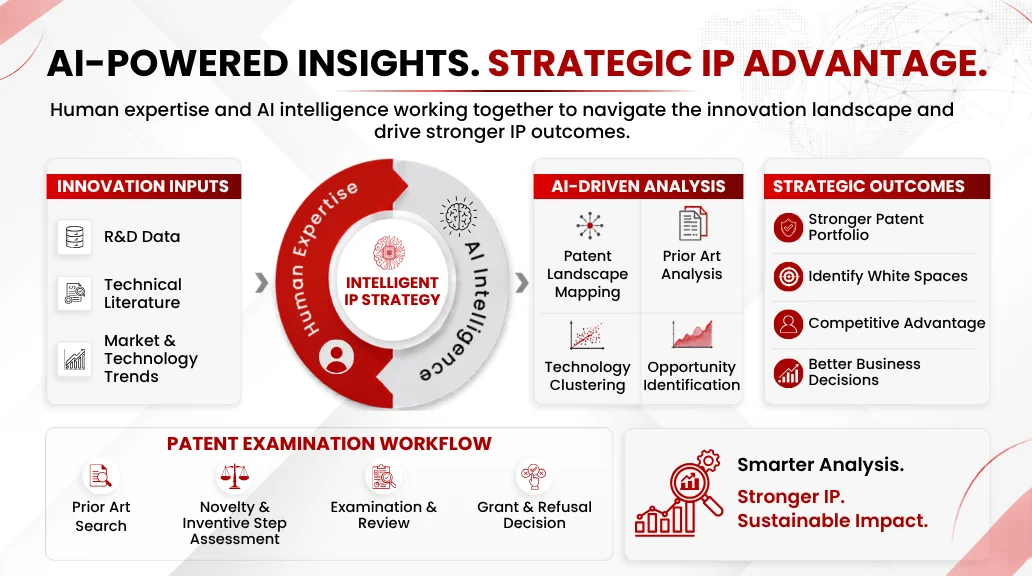
The DABUS Debate: When AI Became Part of the Inventorship Conversation
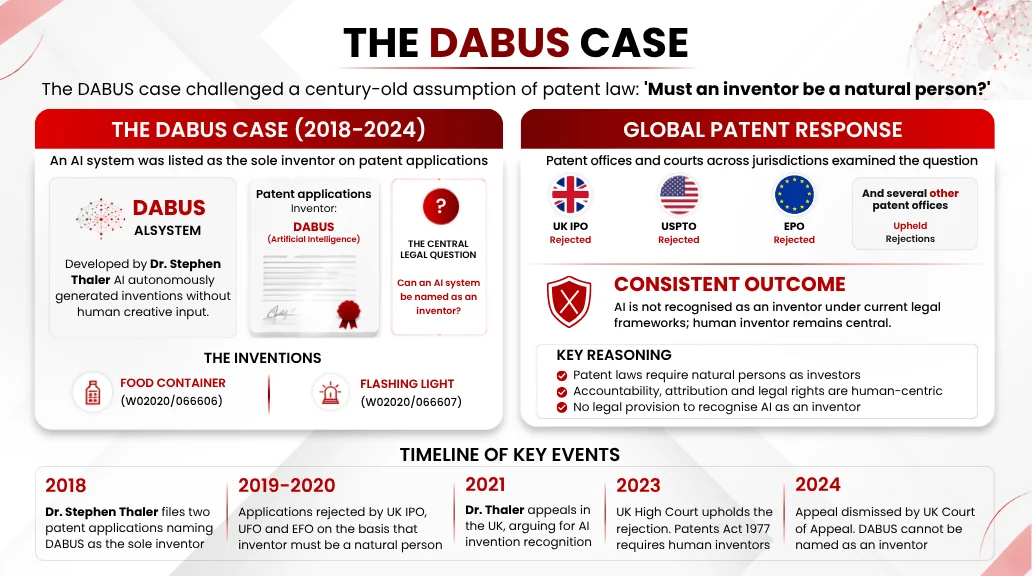
The discussion around AI inventorship gained global attention through the patent applications associated with DABUS, an artificial intelligence system developed by researcher Stephen Thaler.
The applications sought to identify DABUS as the inventor of inventions generated by the AI system. Although patent offices and courts in multiple jurisdictions did not recognise the AI system as an inventor, the significance of the debate extended far beyond the specific applications.
Patent systems have always assumed that the origin of invention can be traced to a human mind.
The legal question was straightforward:
Can an artificial intelligence system be named as an inventor?
But the underlying question was much broader:
If an AI system contributes to generating a novel technical solution, how should that contribution be understood?
The DABUS debate highlighted several unresolved issues:
If an AI system generates a possible solution, but a human identifies its value, performs validation, and brings it into practical use, where does invention occur?
Even if AI contributes technically, does that contribution translate into inventorship?
At what point does an AI system move from being a sophisticated tool to becoming a meaningful contributor to invention?
These questions remain open because technological capability is advancing faster than legal definitions can evolve.
Current Patent Frameworks: Human Inventors Remain at the Centre
Today, major patent jurisdictions continue to place human inventors at the centre of patent systems. However, the discussions surrounding AI are forcing policymakers and patent offices to examine whether existing principles can accommodate future innovation models.
United States: AI as a Tool, Not an Inventor
The United States Patent and Trademark Office (USPTO) has clarified that artificial intelligence systems may assist individuals during the inventive process, but inventorship requires a human contribution.
The current approach maintains a clear distinction:
However, the inventor identified on a patent application must be a natural person.
This leaves a larger question unanswered:
What happens if future AI systems contribute more substantially to developing technical solutions?
Europe: Preserving the Human Inventor Principle
The European Patent Office (EPO) has similarly maintained that inventors must be natural persons.
The European approach reflects a broader principle: patents are not merely rewards for technical output. They recognise human contribution to technological progress.
However, as AI capabilities develop, distinguishing between AI-assisted invention and AI-generated invention may become increasingly complex.
A researcher using AI to analyse data is clearly different from an AI system independently identifying a solution that humans later verify.
The challenge lies in determining where that boundary exists.
Global Discussions: A Need for Alignment
Artificial intelligence does not operate within national borders. Research teams collaborate internationally. AI models are developed in one jurisdiction and deployed globally.
Patent rights, however, remain territorial.
This creates potential complexity around:
Organisations such as the World Intellectual Property Organization (WIPO) continue to examine how intellectual property frameworks may need to respond to emerging technologies.
What Happens to Inventive Step in the Age of AI?
The debate around AI and inventorship often focuses on a simple question:
Can AI be an inventor?
However, for the patent system, an equally important question may be:
Does the increasing availability of AI change what qualifies as an inventive contribution?
Patent systems do not protect every new idea. A technical solution must generally satisfy several requirements, including novelty and an inventive step (or non-obviousness).
The concept of inventive step exists because not every advancement represents a meaningful contribution to technology. A solution may be new, but if it would have been obvious to a person skilled in the relevant field, it may not qualify for patent protection.
Historically, a skilled person was assumed to rely on:
But what happens when AI tools become part of that skilled person’s capabilities?
The future “person skilled in the art” may no longer be a human working alone but a human equipped with increasingly sophisticated computational capabilities.
How patent offices interpret this evolution remains an open question.
When AI Creates Prior Art: A New Challenge for Patent Systems
While AI inventorship receives significant attention, another issue may become equally important:
Could AI-generated information become a source of prior art?
Prior art represents existing knowledge that can affect whether an invention is considered novel. Traditionally, prior art has come from sources such as:
But AI systems can now generate enormous volumes of technical concepts, designs and possible solutions.
This raises several future considerations.
Imagine an AI system exploring thousands of possible semiconductor architectures. Most generated designs may never be commercialised or publicly disclosed.
However, what happens if such AI-generated outputs become accessible through public systems, research platforms or open databases?
These questions have implications for patent searching, freedom-to-operate analysis, technology intelligence and competitive monitoring.
As AI-generated technical information expands, the definition of what constitutes meaningful prior knowledge may require deeper examination. The next challenge for patent systems may also involve understanding what knowledge already exists in a world where machines can generate technical possibilities at unprecedented scale.
The Future of AI and Inventorship: Three Possible Paths
Predicting the exact direction of AI and intellectual property law is difficult. Technology evolves quickly. Legal systems evolve carefully. And the gap between the two creates uncertainty. However, several possible paths can be considered.
Scenario 1: AI Remains a Sophisticated Innovation Tool
The first possibility is that existing patent frameworks continue with limited modification.
Under this approach:
This model offers simplicity and legal certainty.
It also reflects the reality that most current AI applications involve meaningful human involvement. However, this approach may become increasingly difficult to maintain if AI systems become capable of generating increasingly independent technical solutions.
Scenario 2: AI Contribution Becomes More Transparent
A second possibility is that patent systems may place greater emphasis on documenting AI involvement. Future patent applications could potentially include information regarding:
Such an approach would not necessarily recognise AI as an inventor. Instead, it would acknowledge that innovation processes are changing. This could help establish greater transparency while maintaining human inventorship principles.
However, practical challenges remain:
Scenario 3: New Frameworks for Human-AI Innovation
A longer-term possibility is the emergence of new legal concepts that recognise the unique nature of human-AI collaboration. Rather than framing innovation as human invention versus AI invention, future discussions may explore human-led AI-assisted invention. Such a framework could recognise that:
Whether such frameworks emerge will depend on technological development, policy discussions and international cooperation.
Rethinking the Future of Intellectual Property
The debate around AI inventorship is fascinating because it challenges a deeply embedded assumption that invention is a moment of human creation.
However, innovation has never existed in isolation. Human progress has always been shaped by tools. Artificial intelligence represents another stage in this evolution. Its significance lies in how it changes the process through which new ideas emerge.
The future of intellectual property may not be determined by whether AI receives recognition as an inventor. That may be the wrong question. The more important question is:
How can intellectual property systems preserve the value of human creativity while adapting to new models of innovation?
AI may not replace inventors.
But it may redefine what invention looks like.
The organisations that succeed in this new environment will be those that understand how the two can work together to create, protect and strategically leverage innovation.
This article represents Wissen Research’s perspective on the evolving relationship between artificial intelligence and intellectual property. It explores possible future scenarios based on current technological developments, patent office position, and ongoing policy discussions. The views presented are intended for thought leadership and informational purposes and should not be interpreted as predictions of future legal, regulatory or policy outcomes.
The Best Decisions Start With Better Intelligence.
Connect the dots across technology, markets, competition and innovation with research designed to support strategic decision-making.