Why Connected Vehicles Require a New Intellectual Property Strategy?
Every connected vehicle leaving an assembly line today carries far more than advanced engineering, premium materials and sophisticated software. It also embodies thousands of patented technologies originating from companies that may have never manufactured a vehicle.
For much of the automotive industry’s history, competitive differentiation revolved around vehicle performance, manufacturing quality, safety and design. While these factors remain fundamental, the emergence of connected and software-defined vehicles has introduced a parallel layer of competition, one governed not only by engineering excellence, but also by intellectual property rights embedded within global technology standards.
Unlike traditional automotive patents, these technologies often originate from industries with decades of experience in structured licensing, standards development and cross-border patent litigation. Telecommunications companies, semiconductor innovators, codec developers and specialist software firms have built extensive patent portfolios that now underpin many of the features consumers expect in every modern vehicle.
As connected features become indispensable rather than optional, intellectual property is emerging as a strategic business risk that demands the same level of attention as engineering, cybersecurity and regulatory compliance. Understanding how this transformation occurred is the first step toward managing it effectively.
The Automotive Industry’s New IP Reality
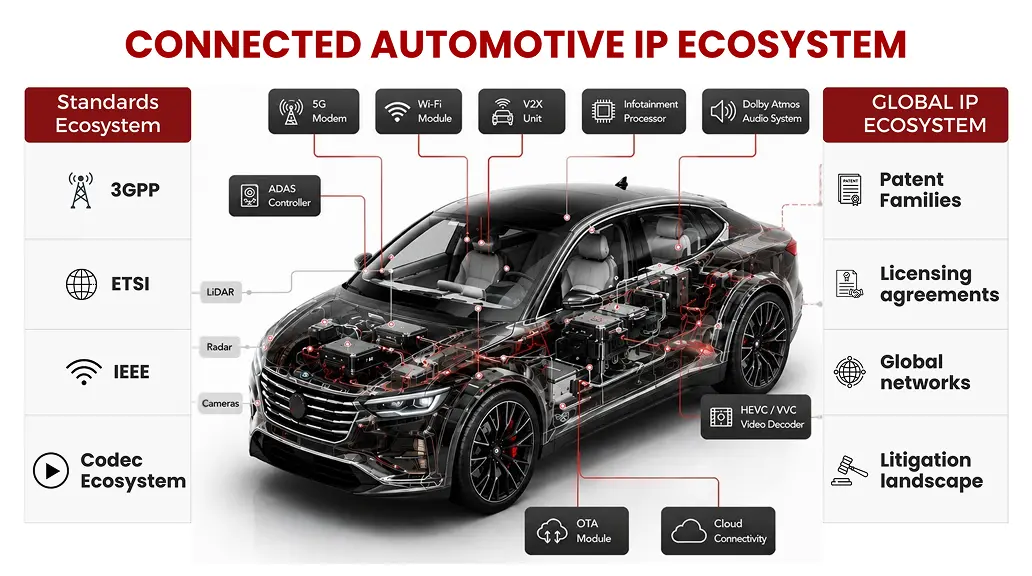
As vehicles evolved from isolated mechanical systems into connected digital platforms, they became dependent on technologies developed and standardized by industries that had little historical connection to automotive manufacturing. Features that consumers now consider essential: emergency calling, real-time navigation, over-the-air software updates, connected infotainment, remote diagnostics and vehicle-to-everything (V2X) communication, are all built upon globally standardized communication technologies.
Unlike many traditional automotive inventions, these technologies cannot simply be substituted with proprietary alternatives. Their interoperability depends on compliance with internationally recognized standards developed through organizations such as 3GPP, ETSI and IEEE. These standards ensure that vehicles can reliably communicate with cellular networks, Wi-Fi infrastructure, cloud services, emergency response systems and an increasingly connected transportation ecosystem.
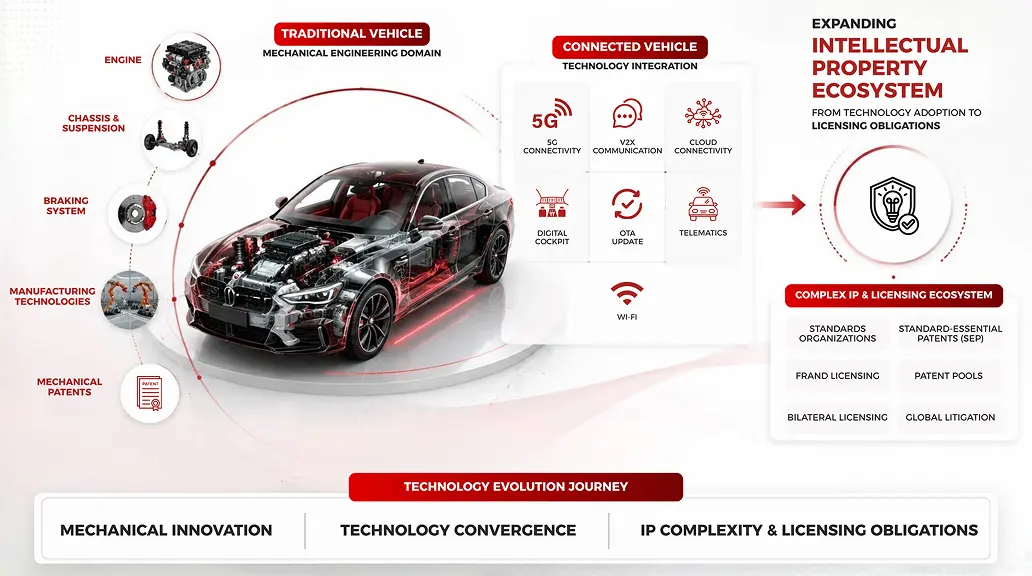
When patented technologies become indispensable to implementing these standards, they are recognized as Standard-Essential Patents (SEPs). SEPs protect technologies that manufacturers must implement to achieve compliance with a technical standard. Designing around them is often impractical without sacrificing interoperability or violating the standard itself. Consequently, connected vehicle manufacturers inherit licensing obligations that have long been familiar to smartphone, networking and telecommunications companies.
From Engineering Standards to Licensing Obligations
To encourage widespread adoption of standardized technologies, SEP owners typically commit to licensing their patents on Fair, Reasonable and Non-Discriminatory (FRAND) terms. In principle, this framework promotes innovation while ensuring that essential technologies remain accessible to all market participants.
In practice, however, determining what constitutes a “fair” royalty, identifying the appropriate licensing level within the supply chain and resolving cross-border jurisdictional differences have become some of the most contested issues in modern patent law.
The widely watched Nokia v. Daimler dispute marked a turning point by demonstrating that connected vehicle manufacturers could become primary targets in global SEP licensing negotiations. At the heart of the case was a fundamental question that continues to shape automotive licensing today:
Should SEP licenses be negotiated with component suppliers or with the vehicle manufacturer selling the finished product?
Although the dispute ultimately concluded through a confidential licensing agreement, its significance extended far beyond the parties involved. As connected functionality became integral to the vehicle itself, licensing responsibilities increasingly shifted toward the companies placing those vehicles on the market.
Must Read: Readers interested in how licensing models are evolving alongside connected and software-defined vehicles may also find our analysis on The Evolution of Automotive Licensing Industry particularly useful.
Why the Risk Remained Hidden
The growing influence of telecom, connectivity and codec patents did not emerge overnight. It evolved gradually, alongside the digitization of the automobile itself. Yet despite years of technological progress, patent exposure associated with connected vehicles remained largely outside the strategic focus of many automotive organizations.
This was not because the risks were insignificant. Rather, the industry’s organizational structure, supply chain and historical experience made them difficult to recognize until connectivity became indispensable.
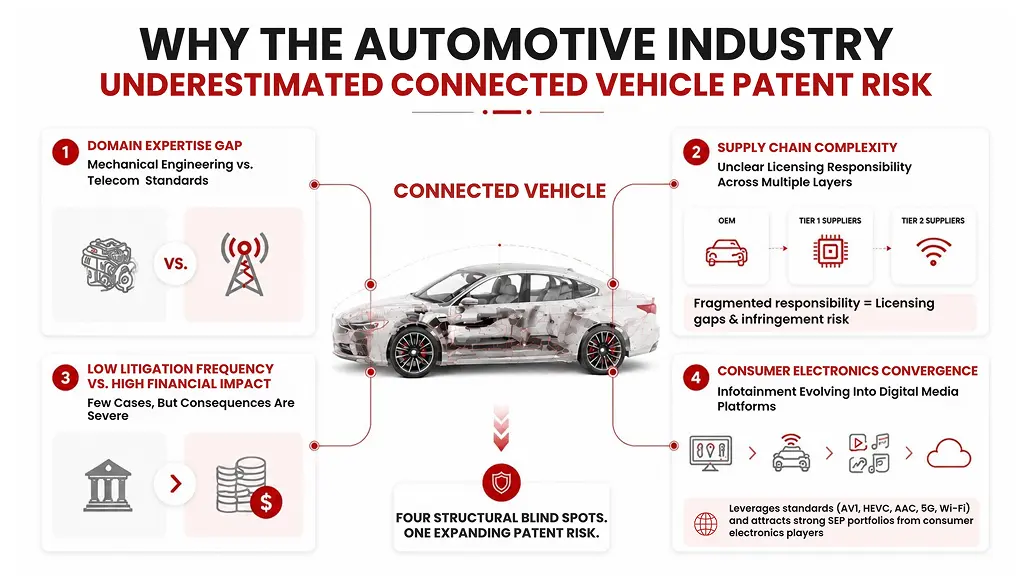
Four structural factors, working together rather than independently, explain why this transformation remained largely hidden.
Blind Spot 1: Expertise Gap Between Automotive and Telecommunications
For decades, automotive IP strategies focused primarily on mechanical engineering, manufacturing processes, safety systems, and vehicle architecture. However, connected vehicle technologies such as cellular connectivity, Wi-Fi, codecs and cloud platforms introduced unfamiliar patent ecosystems governed by standards, SEPs, FRAND licensing and global patent pools. Automakers were required to develop expertise in technology domains that had historically evolved outside the automotive industry.
Blind Spot 2: Supply Chain Complexity Masked Licensing Responsibility
Connected vehicles rely on a multi-layered supply chain involving OEMs, Tier 1 suppliers and Tier 2 technology providers. While suppliers often develop critical connectivity components, SEP holders increasingly prefer licensing the final vehicle manufacturer where multiple technologies converge and commercial value is realized. This created uncertainty over licensing responsibility across the automotive value chain.
Blind Spot 3: Low Litigation Frequency Created False Security
Connected vehicle patent disputes have historically been less frequent than other business risks, creating a perception that exposure was limited. However, individual cases have demonstrated significant financial and operational impact through royalty demands, prolonged negotiations and potential sales restrictions. The risk is therefore defined by high impact rather than litigation frequency.
Blind Spot 4: Infotainment Quietly Became Consumer Electronics
Modern infotainment systems increasingly resemble consumer electronics platforms, supporting streaming, smartphone integration, premium audio, and high-resolution video experiences. Technologies such as HEVC, VVC, AV1, Dolby formats and digital media platforms introduce automotive companies to established patent ecosystems with complex licensing and royalty structures. As a result, automakers have inherited IP challenges traditionally managed by electronics and media industries.
Bringing the Four Blind Spots Together
Individually, each of these structural factors might have been manageable. Together, they created the conditions for a much larger strategic blind spot.
Automotive organizations entered mature telecommunications and media patent ecosystems without immediately recognizing how fundamentally different those ecosystems were from traditional automotive intellectual property. Connectivity technologies arrived through suppliers, litigation appeared relatively infrequent and infotainment continued to be viewed primarily as a product feature rather than a gateway into entirely new licensing environments.
By the time connected vehicles became the industry standard, patent exposure had already expanded across multiple technology domains.
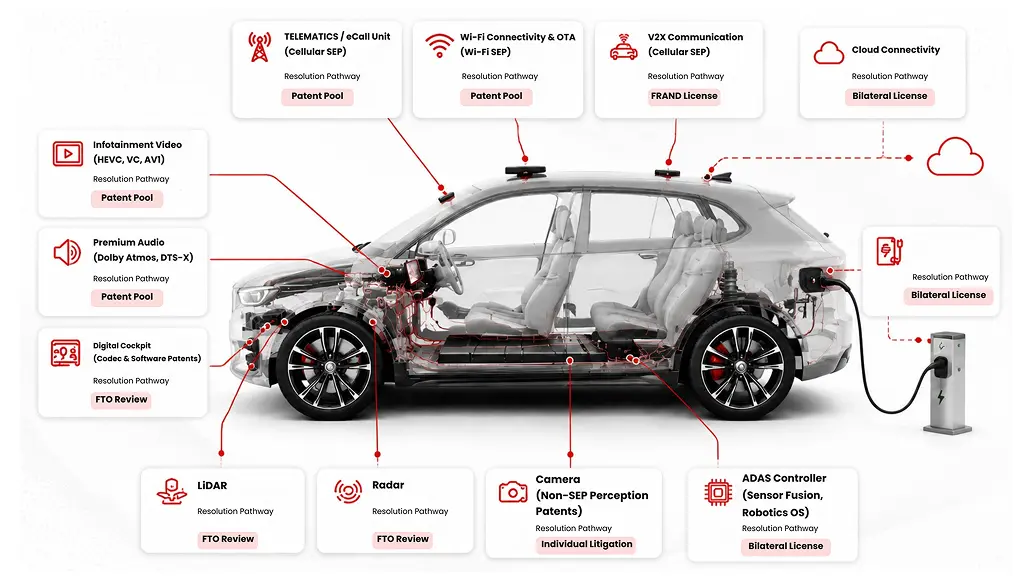
Where Patent Risk Is Concentrating
Understanding why the automotive industry underestimated connected vehicle patent exposure explains how the challenge emerged. The next question is more practical:
Where is this risk actually concentrated today?
The answer extends well beyond a single technology or licensing program.
A modern connected vehicle operates within several distinct patent ecosystems, each developed independently over many years and each governed by its own standards, licensing practices, commercial incentives and litigation history.
While these ecosystems occasionally overlap, they differ significantly in how patent rights are exercised and how disputes are resolved. Some rely on structured licensing pools supported by FRAND commitments while others are characterized by fragmented ownership and individual enforcement actions.
Together, they represent one of the most significant shifts in automotive intellectual property over the past decade.
Connected vehicles rely on standardized cellular technologies (2G–5G) to enable critical functions such as telematics, emergency calling, remote diagnostics, navigation, software updates, fleet management and V2X communication. Since these technologies depend on global standards, manufacturers must address the associated Standard-Essential Patent (SEP) licensing obligations.
The automotive connectivity licensing landscape has evolved into a structured ecosystem, led by platforms such as Avanci, which consolidates cellular SEP portfolios from companies including Ericsson, Nokia, Qualcomm, and InterDigital. Its licensing framework now covers more than 250 million connected vehicles and over 140 automotive brands globally.
This ecosystem continues to expand beyond cellular connectivity. Avanci’s Wi-Fi 6 Vehicle Program, along with increasing licensing activity involving companies such as OPPO, Nokia, and other technology providers, demonstrates that connectivity licensing has become a fundamental part of connected mobility.
Automotive connectivity licensing has therefore evolved from individual patent negotiations into a mature commercial framework similar to the licensing environment historically experienced by the smartphone industry.
A decline in the number of headline SEP disputes does not necessarily indicate declining risk. Instead, the geography of enforcement is evolving.
While jurisdictions such as Germany, the United Kingdom and the United States remain influential venues for SEP litigation, recent developments demonstrate that automotive patent enforcement is becoming increasingly international.
Brazil provides a compelling example.
Proceedings involving IP Bridge v. BYD and related actions initiated by Avanci member companies illustrate how emerging jurisdictions are developing specialized judicial processes for resolving automotive SEP disputes.
For OEMs operating globally, this has important strategic implications.
Patent exposure can no longer be evaluated solely through traditional litigation hotspots. As connected vehicle adoption expands across international markets, licensing disputes are increasingly likely to emerge wherever significant commercial activity exists.
In practical terms, the geographic footprint of connected vehicles is rapidly becoming the geographic footprint of automotive patent enforcement.
While cellular SEPs introduced automakers to telecommunications licensing, audio-video codecs are exposing them to the patent complexities of consumer electronics. Modern infotainment systems now support streaming, smartphone mirroring, immersive audio, cloud-based content and premium digital experiences that rely on technologies such as HEVC, VVC, AV1, Dolby formats and DTS.
As a result, connected vehicles are inheriting licensing challenges traditionally associated with televisions, smartphones and streaming platforms. This shift is reflected in industry developments, with Mercedes-Benz showcasing Dolby Atmos, Dolby Vision, DTS AutoStage Video and IMAX Enhanced experiences at CES 2026.
The underlying licensing ecosystem is equally complex. Access Advance manages patent pools covering more than 29,000 HEVC patents and over 4,500 VVC patents, while its Video Distribution Patent Pool consolidates licensing for HEVC, VVC, VP9 and AV1 technologies.
The recent Dolby v. Snap dispute further highlights that even royalty-free codecs such as AV1 may carry patent risks. For automakers, codec-related freedom-to-operate analysis is becoming as critical as connectivity licensing as vehicles evolve into software-defined multimedia platforms.
Who Bears the Impact Across the Automotive Value Chain?
Connected vehicle patent exposure does not affect every stakeholder equally. While technology development is distributed across suppliers, software providers and technology partners, commercial and legal consequences often concentrate at specific points in the value chain.
A Five-Pillar Framework for Automotive IP Risk Management
Connected vehicle technologies will continue to evolve, bringing new standards, software platforms, multimedia capabilities and AI-driven functions into the automotive ecosystem. As this complexity increases, managing intellectual property solely through reactive licensing negotiations or litigation responses is no longer sufficient.
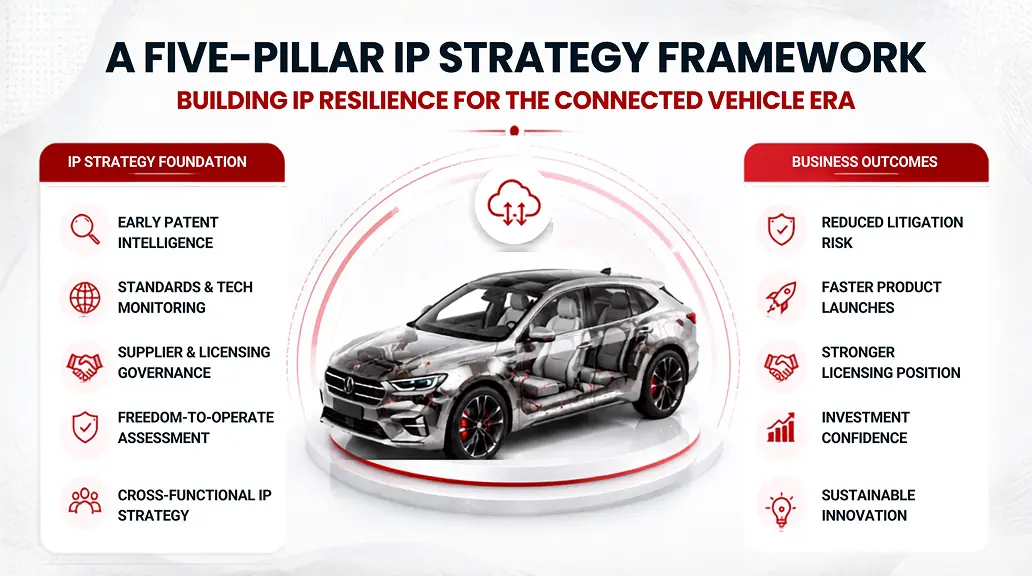
Based on the trends discussed throughout this article, five priorities are emerging for automotive organizations seeking to strengthen their IP readiness.
Pillar 1: Build Patent Intelligence Into Technology Planning
When evaluating technologies such as cellular communication, Wi-Fi, codecs, AI perception systems, or cloud connectivity, organizations should assess not only technical performance but also the surrounding patent landscape, licensing models and freedom-to-operate implications. Early visibility enables better technology selection, more informed commercial negotiations and fewer downstream surprises.
Pillar 2: Monitor Standards Alongside Patents
In connected vehicles, standards often shape future patent exposure before products reach the market. Monitoring developments within organizations such as 3GPP, ETSI, IEEE, MPEG and relevant codec alliances provides valuable insight into emerging technologies that may later become commercially essential.
Pillar 3: Strengthen Supplier and Licensing Governance
As connected vehicle architectures become increasingly modular, intellectual property responsibilities should be addressed with the same rigor as technical specifications and commercial terms.
Organizations should establish clear governance around:
Clearly defining these responsibilities early in development reduces ambiguity as products move toward commercialization.
Pillar 4: Conduct Continuous Freedom-to-Operate Assessments
Software-defined vehicles evolve continuously through over-the-air updates, feature additions, cloud integrations and new multimedia capabilities. Each change has the potential to introduce new patent considerations. Periodic FTO assessments help organizations identify emerging risks before they develop into licensing disputes or litigation.
Pillar 5: Create Cross-Functional IP Governance
Connected vehicle intellectual property can no longer be managed exclusively by legal departments.
Effective IP management therefore requires collaboration across engineering, legal, procurement, product management, standards teams and executive leadership.
Future Outlook: The Evolution of Automotive IP Strategy
The next phase of automotive innovation will be defined not only by what vehicles can do, but by the complex technology ecosystems that enable those capabilities.
As connected vehicles continue evolving into intelligent, software-driven platforms, the integration of telecommunications, artificial intelligence, cloud services, multimedia technologies and advanced sensing systems will accelerate. With each new layer of technology, automakers will increasingly interact with established patent ecosystems beyond traditional automotive boundaries.
Future competition will therefore extend beyond vehicle design and engineering excellence. The ability to identify technology dependencies, navigate licensing landscapes and build proactive IP strategies will become a critical differentiator for OEMs, suppliers and emerging mobility companies.
Organizations that develop strong IP intelligence capabilities today will be better positioned to manage licensing obligations, reduce disruption, negotiate from a position of strength and accelerate innovation with greater confidence.
The connected vehicle era will not be shaped only by those who understand and strategically manage the intellectual property ecosystems behind them.
The Best Decisions Start With Better Intelligence.
Connect the dots across technology, markets, competition and innovation with research designed to support strategic decision-making.