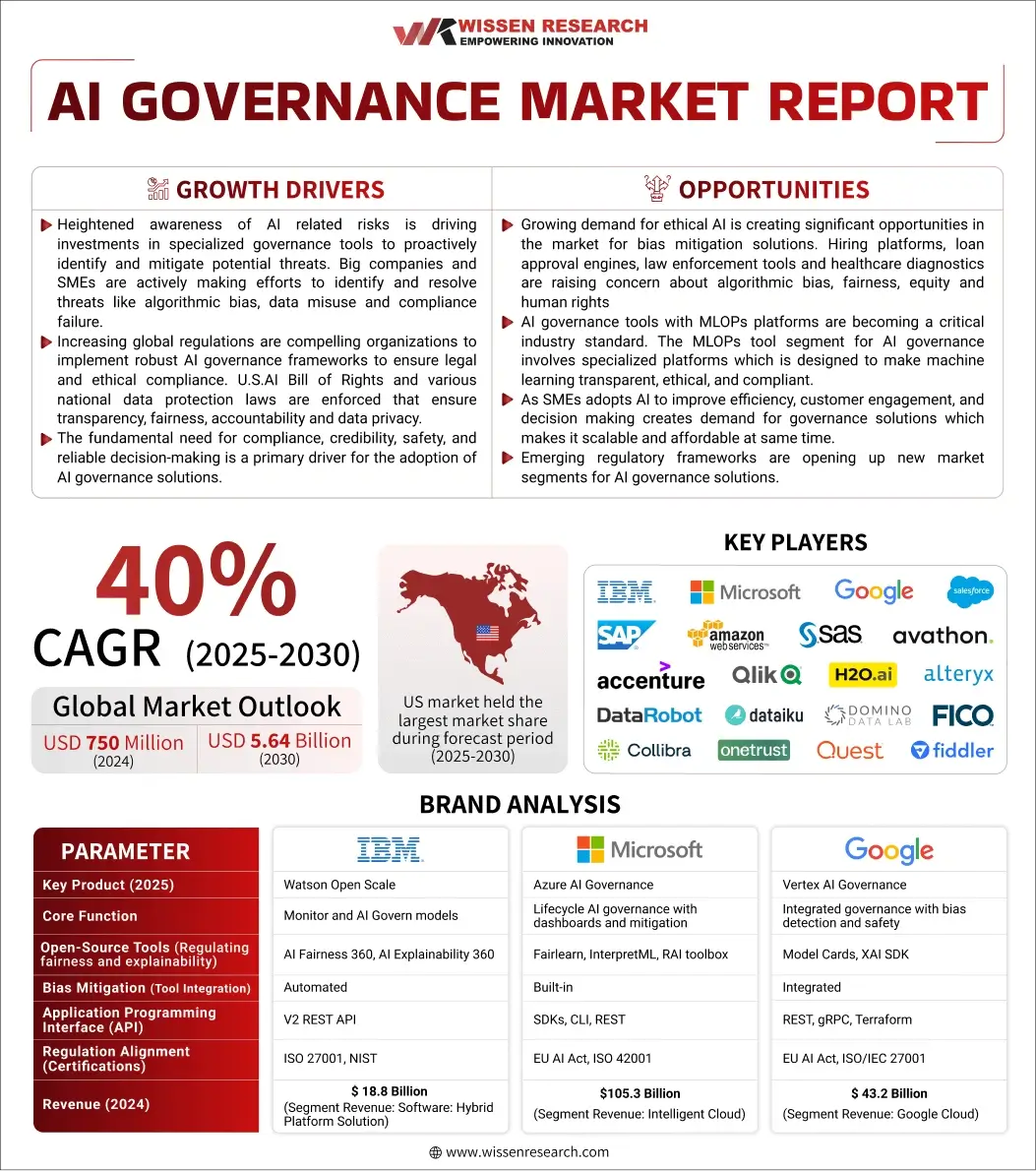
Wissen Research analyzed that the global AI Governance market was valued at USD 750 million in 2024 and is projected to reach USD 5.64 billion by 2030, expected to grow at a CAGR of 40% during the forecast period, 2025-2030.
Furthermore, the US with USD 232.5 million market in 2024, held a significant share in the global AI governance market and is likely to show the highest growth at a CAGR of 40% within this market, during the forecast period (2025-2030).
Global AI Governance market is anticipated to reach USD 5.64 billion by 2030 from USD 750 million in 2024, growing at an annualized rate of 40% during the period, 2025-2030. | North America driven by the United States and Canada, is home for major technology companies, significant venture capital funding, and a strong culture of innovation in AI ethics. The region benefits from established tech ecosystems in hubs like Silicon Valley and Seattle, along with early and proactive regulatory from bodies like the U.S. National Institute of Standards and Technology. | Asia-Pacific In Asia-Pacific, surging demand for deployment of Al at scale in healthcare, BFSI, and manufacturing, driving the need for governance frameworks. Government investment and policy focus on Al ethics and compliance further fuel rapid market expansion. |
AI Governance market is undergoing rapid transformation as advancements in model creation, data processing, and application development expand AI capabilities across commercial, public, and government sectors. AI is heavily involved in content creation, software development, and customer service. This transition is driving the demand for AI governance, raising concern globally over content authenticity, intellectual property, and ethical AI deployment. | Global investment in AI Governance ecosystems—including bias detection tools, data privacy frameworks, and compliance platforms, are being reinforced by new regulatory policies, particularly in content regulation, intellectual property protection, and transparent decision-making. The AI Governance market is currently facing significant challenges apart from technical ones, like rapidly evolving regulatory environment, internal organizational resistance to new compliance procedures, and public trust regarding AI transparency. |
Drivers: Shifting from Risk Awareness to Action, as AI Governance Tools are Soaring Market Growth
The increasing demand of AI governance boosts a significant shift from AI related risks to taking structured and actionable steps through governance like European Union’s AI Act, which came into force in 2024 enforcing legal classifications for AI systems based on risk, transparency, and compliance. Similarly, in India, Odisha government approved its AI policy for 2025 targeting sectors like governance, education and agriculture through its AI deployment, all these steps mark a movement form high level awareness to systematic policy deployment. A rise in enterprise level tools has been observed, which is driven by the growing needs for companies mainly from finance, healthcare and public services to maintain their reputation, follow legal rules and to run their operations safely and efficiently.
Opportunities: Emerging Demand for Flexible AI Oversight Tools among SMEs
As SMEs adopts AI to improve efficiency, customer engagement, and decision making creates demand for governance solutions which makes it scalable and affordable at same time. Vendors are responding for developing platforms, automated monitoring systems and user-friendly dashboards that allows SMEs to manage AI risk, these solutions are often cloud based, subscription driven and designed to work seamlessly which make them ideal for fast growing businesses. Unlike big enterprises, SMEs lacks dedicated compliance teams and AI ethics experts, that creates a growing market opportunity for simplified, modular AI governance tools which can ensure responsible AI use without any complexity.
Challenges: AI Risk and Governance Awareness Gap
An AI generative company which provides AI-powered customer service like chatbot which needs to improve their response times, but fails to configure it properly, leading to a data breach where it inadvertently exposes a customer’s private financial information. AI risk and governance awareness gap causes many organizations to implement fragmented governance that fails to align with business value which limits the understanding and leads to common pitfalls like regulatory deployment and outdated tools that hinder scalability. Critical gap is emerging between the risk AI poses and awareness among organizations like SMEs that’s brings risks, as many businesses are deploying AI systems without fully understanding the implementation. This challenge brings both a responsibility and opportunity for vendors, regulators and stakeholders who are investing a huge amount in AI governance
AI governance is used to ensure ethical operations, build customer trust and gain a competitive advantage. This is happening because of three main reasons which includes new government rules, companies realizing AI can be risky, and businesses need to build trust among the users. New regulations like the EU AI Act are forcing companies to adopt better governance to avoid fines and bad publicity. Problems like biased AI and AI failures result for not managing AI properly, that is why companies are investing in governance tools to reduce these risks. Companies are realizing that AI governance is more than just a cost, it becomes a necessity that helps to build customer trust, ensures ethical operations, and gives a company a competitive edge.
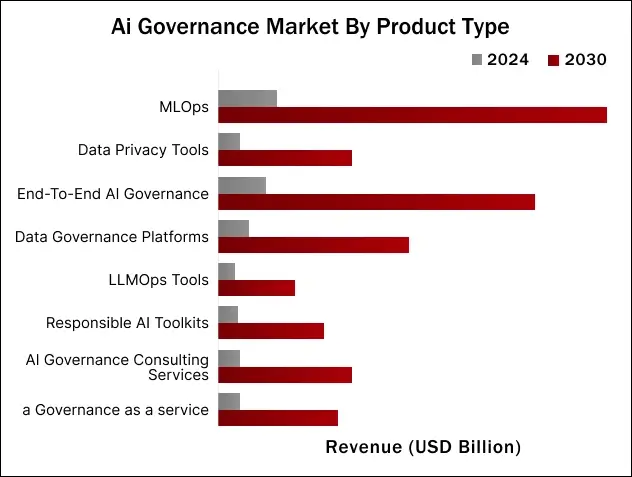
MLOps tool segment projected to hold majority market share the AI Governance Market by product type in the forecast period (2025-2030)
The MLOps tool segment for AI governance involves specialized platforms which is designed to make machine learning transparent, ethical, and compliant. An MLOps governance tool provides the central platform to automatically enforce region-specific compliance rules, continuously monitor the model for bias, and generate the audit trails required by regulators in the EU, US, and Asia. This integrated, automated approach is essential for managing risk at scale, proving why MLOps tools are the backbone of the AI governance market.
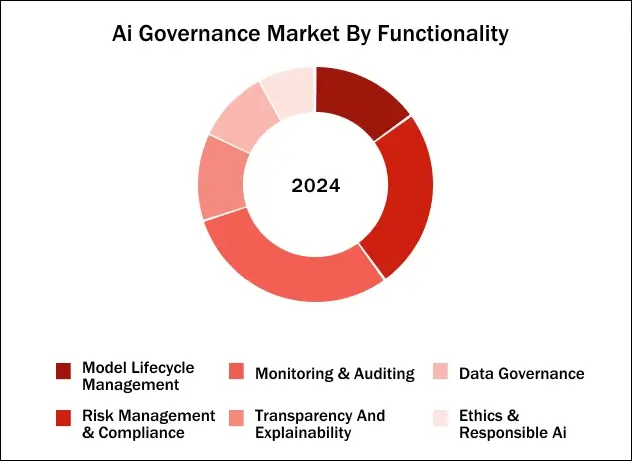
Monitoring and Auditing segments accounted for the largest market share in 2024 by Functionality
Monitoring and Auditing form the backbone of AI Governance, driven by functionality which address critical challenges and ensure that AI remains safe, complaint, and trustworthy after it is deployed. Continuous monitoring of AI models to detect problems like bias, drift, security issues, automatically checking for rule breaking and ensuring AI operates fairly and ethically. Systematized audit engages operational processes to verify adherence to governance policies, ethical guidelines, legal frameworks, model decisions and data lineage.
North America held the largest market share in AI Governance in 2024
North America commanded the highest market share in the AI Governance industry in 2024, supported by a powerful combination of early regulatory action (U.S. Federal Trade Commission (FTC)), National Institute of Standards and Technology (NIST), a dominant tech ecosystem, and high enterprise AI adoption. This dynamic regulatory environment, coupled with the presence of major technology hubs in Silicon Valley and beyond, has fostered a dense ecosystem for both established vendors and innovative startups.
Meanwhile, Asia Pacific is expected to log the highest market growth rate of any region during the forecast period owing to the surging demand for deployment of Al at scale in healthcare, BFSI, and manufacturing and government investment and policy focus on Al ethics and compliance further fuel rapid market expansion.
Major players operating in AI Governance market are:
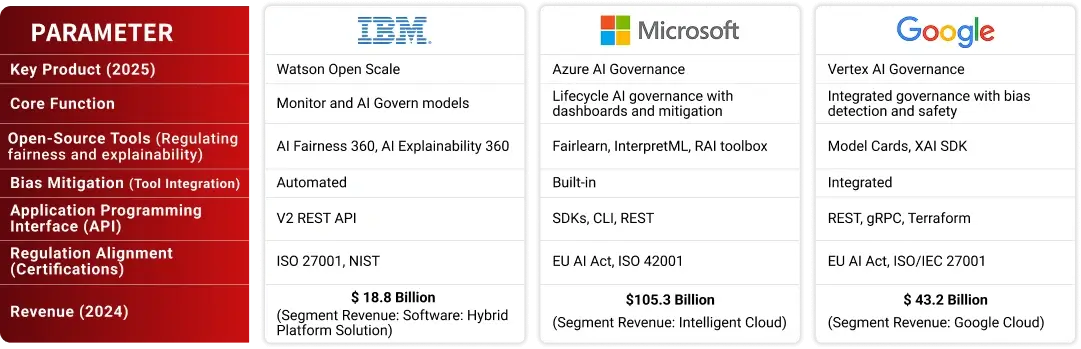
Note: The above revenue has been collected from company websites annual report and SEC filing, latest as of 2024.
Sources: Secondary Research
“AI governance has moved from a simple compliance task to being a core part of managing risk. It is now essential for managing risk, and getting it wrong can directly harm how people see your brand and whether they trust you.”
CEO – Global Financial Services Firm (North America)
“Developing a moral AI model is step one, but the hard part is keeping it under control and training it as laws evolve, which is extremely difficult because AI governance is racing ahead.”
Head of Operational Risk – Major Insurance Provider (North America)
“There’s a huge and growing demand for tools that can explain how AI makes its decisions. These tools are needed not only to satisfy government regulators but also to help the company’s own employees and manager to trust the AI decisions.”
Vice President – AI Governance Platform Provider (Asia-Pacific)
“The big challenge is creating a federated system for AI governance which means finding the right balance between having strong, central rules for the whole company and allowing different departments or regions to have the flexibility to innovate and adapt those rules to their specific needs.”
Managing Director– Major Consulting Firm (North America)
Sources: Primary Research and Wissen Research Analysis.
Note: Above mention is non-exhaustive samples of the primary insights.
Particulars | Details |
Report | AI Governance Market |
Forecast Period | 2025-2030 |
Base Year | 2024 |
Format | |
Market Size (2024) | USD 750 Million |
CAGR (2025-2030) | 40% |
Number of Pages | 165 |
Number of Tables | 155 |
Number of Figures | 34 |
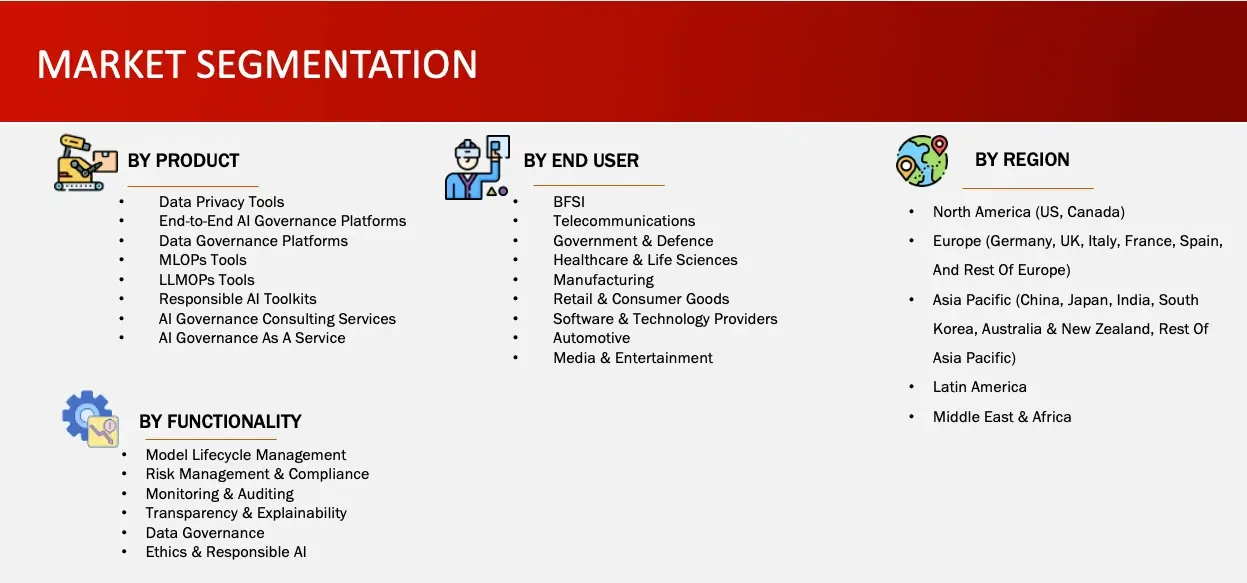
Key Segments | AI Governance Market by Product Type (Data Privacy Tools, End-To-End AI Governance Platforms, Data Governance Platforms, MLOpS Tools, LLMOpS Tools, Responsible AI Toolkits, AI Governance Consulting Services, AI Governance as a Service) AI Governance Market by Functionality (Model Lifecycle Management, Risk Management & Compliance, Monitoring & Auditing, Transparency & Explainability, Data Governance, Ethics & Responsible AI) AI Governance Market by End User (BFSI, Telecommunications, Government & Defence, Healthcare & Life Sciences, Manufacturing, Retail & Consumer Goods, Software & Technology Providers, Automotive, Media & Entertainment) |
Regions Covered | § North America: US and Canada § Europe: Germany, UK, France, Italy, Spain, and Rest of the Europe § Asia-Pacific: China, Japan, India, South Korea, Australia and New Zealand, and Rest of the Asia-Pacific § Latin America § Middle East and Africa |
Key Players Covered (Majority Share Holders) | International Business Machines Corporation (IBM) (US), Microsoft Corporation (US), Google (Alphabet Inc.) (US), Salesforce, Inc. (US), SAP SE (Germany), Amazon.Com, Inc. (US), SAS Institute Inc. (US), Fair Isaac Corp (FICO) (US), Accenture PLC (Ireland) |
Other Players | Qlik Technologies Inc (US), H2O.ai, Inc. (US), Alteryx, Inc. (US), Datarobot, Inc. (UK), Dataiku (US), Domino Data Lab, Inc. (US), Avathon, Inc. (US), Collibra (US), OneTrust, LLC. (US), Quest Software Inc. (US), Fiddler Labs, Inc. (US) |
1. INTRODUCTION
1.1. KEY OBJECTIVES
1.2. DEFINITIONS
1.2.1. IN SCOPE
1.2.2. OUT OF SCOPE
1.3. SCOPE OF THE REPORT
1.4. SCOPE RELATED LIMITATIONS
1.5. KEY STAKEHOLDERS
2. RESEARCH METHODOLOGY
2.1. RESEARCH APPROACH
2.2. RESEARCH METHODOLOGY / DESIGN
2.3. MARKET SIZE ESTIMATION APPROACHES
2.3.1. SECONDARY RESEARCH
2.3.2. PRIMARY RESEARCH
2.3.2.1. KEY INSIGHTS FROM INDUSTRY EXPERTS
2.4. DATA VALIDATION & TRIANGULATION
2.5. ASSUMPTIONS OF THE STUDY
3. EXECUTIVE SUMMARY & PREMIUM CONTENT
3.1. GLOBAL MARKET OUTLOOK
3.2. KEY MARKET FINDINGS
4. MARKET OVERVIEW
4.1. AI GOVERNANCE MARKET: OVERVIEW
4.1.1. INTRODUCTION
4.2. MARKET DYNAMICS
4.2.1. MARKET DRIVERS
4.2.2. MARKET OPPORTUNITIES
4.2.3. RESTRAINTS/CHALLENGES
4.3. END USER PERCEPTION
4.4. NEED GAP ANALYSIS
4.5. KEY CONFERENCES
4.6. SUPPLY CHAIN / VALUE CHAIN ANALYSIS
4.7. INDUSTRY TRENDS
4.8. PORTER’S FIVE FORCES ANALYSIS
4.9. REGULATORY LANDSCAPE
4.9.1.NORTH AMERICA
4.9.2.EUROPE
4.9.3.ASIA PACIFIC
5. PATENT ANALYSIS
5.1. TOP ASSIGNEES
5.2. GEOGRAPHY FOCUS OF TOP ASSIGNEES
5.3. LEGAL STATUS
5.4. TECHNOLOGY EVOLUTION
5.5. KEY PATENTS
5.6. PATENT TRENDS AND INNOVATIONS
6. AI GOVERNANCE MARKET, BY PRODUCT TYPE (2024-2030, USD MILLION)
6.1. DATA PRIVACY TOOLS
6.2. END-TO-END AI GOVERNANCE PLATFORMS
6.3. DATA GOVERNANCE PLATFORMS
6.4. MLOPS TOOLS
6.4.1.MODEL DEVLOPMENT
6.4.2.MODEL DEPLOYMENT
6.4.3.MODEL MONITORING
6.5. LLMOPS TOOLS
6.6. RESPONSIBLE AI TOOLKITS
6.7. AI GOVERNANCE CONSULTING SERVICES
6.8. AI GOVERNANCE AS A SERVICE
7. AI GOVERNANCE MARKET, BY FUNCTIONALITY (2024-2030, USD MILLION)
7.1. MODEL LIFECYCLE MANAGEMENT
7.1.1.AUTOMATED VERSIONING
7.1.2.MODEL-IN-PRODUCTION MANAGEMENT
7.1.3.AI INVENTORY MANAGEMENT
7.1.4.MODEL DIVERGENCE DETECTION
7.2. RISK MANAGEMENT & COMPLIANCE
7.2.1.MODEL RISK MANAGEMENT
7.2.2.REGULATORY COMPLIANCE
7.2.3.RISK IDENTIFICATION & MITIGATION
7.2.4.THIRD0PARTY RISK EVALUATION
7.3. MONITORING & AUDITING
7.3.1.AI MODEL MONITORING
7.3.2.DRIFT & BIAS MITIGATION
7.3.3.ANOMALY DETECTION
7.3.4.PERFORMANCE DEGRADATION ALERTS
7.4. TRANSPARENCY & EXPLAINABILITY
7.4.1.MODEL PREDICTION EXPLAINABILITY
7.4.2.MODEL TRANSPARENCY
7.4.3.MODEL DOCUMENTATION & REPORTING
7.5. DATA GOVERNANCE
7.5.1.DAT LINEAGE
7.5.2.DATA DISCOVERY & CLASSIFICATION
7.5.3.DATA PROVENANCE
7.6. ETHICS & RESPONSIBLE AI
7.6.1.AI POLICY CREATION
7.6.2.POLICY BREACH ALERTS
7.6.3.AI ETHICS MANAGEMENT
7.6.4.ADHERENCE VALIDATION
7.6.5.AI REGISTRY
8. GLOBAL AI GOVERNANCE MARKET, BY END USER (2024-2030, USD MILLION)
8.1. BFSI
8.1.1.BANKING
8.1.2. FINANCIAL SERVICES
8.1.3.INSURANCES
8.2. TELECOMMUNICATIONS
8.3. GOVERNMENT & DEFENCE
8.4. HEALTHCARE & LIFE SCIENCES
8.5. MANUFACTURING
8.6. RETAIL & CONSUMER GOODS
8.7. SOFTWARE & TECHNOLOGY PROVIDERS
8.8. AUTOMOTIVE
8.9. MEDIA & ENTERTAINMENT
9. GLOBAL AI GOVERNANCE MARKET, BY REGION (2024-2030, USD MILLION)
9.1. NORTH AMERICA
9.1.1. US
9.1.2. CANADA
9.2. EUROPE
9.2.1. GERMANY
9.2.2. FRANCE
9.2.3. SPAIN
9.2.4. ITALY
9.2.5. UK
9.2.6. NETHERLAND
9.2.7. REST OF THE EUROPE
9.3. ASIA-PACIFIC
9.3.1. CHINA
9.3.2. JAPAN
9.3.3. INDIA
9.3.4. SINGAPORE
9.3.5. AUSTRALIA
9.3.6. SOUTH KOREA
9.3.7. REST OF THE ASIA-PACIFIC
9.4. MIDDLE EAST & AFRICA
9.5. LATIN AMERICA
10. COMPETITIVE ANALYSIS
10.1. REVENUE ANALYSIS
10.2. KEY PLAYERS FOOTPRINT ANALYSIS
10.3. MARKET SHARE ANALYSIS (2023/2024)
10.4. REGIONAL SNAPSHOT OF KEY PLAYERS
10.5. R&D EXPENDITURE OF KEY PLAYERS
10.6. BRAND/ PRODUCT COMPARISON
11. COMPANY PROFILES
11.1. INTERNATIONAL BUSINESS MACHINES CORPORATION (IBM) (US)
11.1.1. BUSINESS OVERVIEW
11.1.2. PRODUCT PORTFOLIO
11.1.3. FINANCIAL SNAPSHOT
11.1.4. RECENT DEVELOPMENTS
11.1.4.1. MERGER/ACQUISITIONS
11.1.4.2. PRODUCT APPROVAL/LAUNCHES
11.1.4.3. PARTNERSHIP/COLLABORATIONS/AGREEMENTS
11.1.4.4. EXPANSIONS
11.2. MICROSOFT CORP (US)
11.3. GOOGLE (ALPHABET INC.) (US)
11.4. SALESFORCE, INC. (US)
11.5. SAP SE (GERMANY)
11.6. AMAZON.COM, INC. (US)
11.7. SAS INSTITUTE INC. (US)
11.8. FAIR ISAAC CORP (FICO) (US)
11.9. ACCENTURE PLC (IRELAND)
11.10. OTHER PLAYERS
11.10.1. ONETRUST, LLC. (US)
11.10.2. QLIK TECHNOLOGIES INC. (US)
11.10.3. H2O.AI (US)
11.10.4. ALERYX, INC. (US)
11.10.5. DATAROBOT, INC. (UK)
11.10.6. DATAIKU (US)
11.10.7. DOMINO DATA LABS, INC. (US)
11.10.8. AVATHON, INC. (US)
11.10.9. COLLIBRA (US)
11.10.10. QUEST SOFTWARE, INC. (US)
11.10.11. FIDDLER LABS, INC. (US)
12. APPENDIX
12.1. INDUSTRY SPEAK
12.2. QUESTIONNAIRE/DISCUSSION GUIDE
12.3. AVAILABLE CUSTOM WORK
12.4. ADJACENT STUDIES
12.5. AUTHORS
13. REFERENCES
The AI Governance market involves the design, development, and enforcement of frameworks, tools, and processes to ensure the ethical, compliant, and responsible use of artificial intelligence systems. It encompasses a broad range of capabilities across enterprise, public-sector, and societal domains. AI governance solutions include core AI technologies (e.g., machine learning, generative AI) supported by specialized tools such as governance platforms, audit systems, and modules, as companies adopt these technologies few challenges start to occur such as security flaw, regulatory penalties, unfair, or even dangerous mistakes if not managed properly.
FIGURE: Al GOVERNANCE MARKET SEGMENTS
Sources: Company Websites and Wissen Research Analysis
Key Stakeholders
Key Study Objectives
Research Methodology
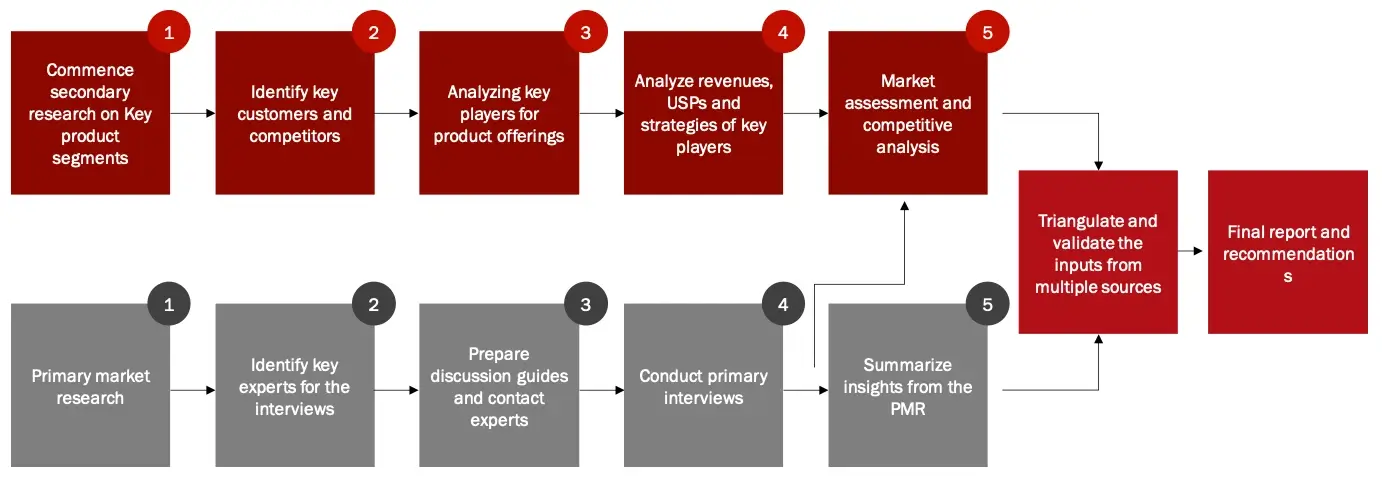
The objective of the study is to analyze the key market dynamics such as drivers, opportunities, challenges, restraints, and key player strategies. To track company developments such as product launches and approvals, expansions, and collaborations of the leading players, the competitive landscape of the Al governance market to analyze market players on various parameters within the broad categories of business and product strategy. Top-down and bottom-up approaches will be used to estimate the market size. To estimate the market size of segments and sub segments the market breakdown and data triangulation will be used.
FIGURE: RESEARCH DESIGN
Sources: Wissen Research Analysis
Research Approach
Collecting Secondary Data
The secondary research data collection process involves the usage of secondary sources, directories, databases, annual reports, investor presentations, and SEC filings of companies. Secondary research will be used to identify and collect information useful for the extensive, technical, market-oriented, and commercial study of the Al governance market. A database of the key industry leaders will also be prepared using secondary research.
Collecting Primary Data
The primary research data will be conducted after acquiring knowledge about the Al governance market scenario through secondary research. A significant number of primary interviews will be conducted with stakeholders from both the demand side and supply side (including various industry experts, such as Directors, Chief X Officers (CXOs), Vice Presidents (VPs) from business development, marketing and product development teams, product manufacturers) across major countries of North America, Europe, Asia Pacific, and Rest of the World. Primary data for this report was collected through questionnaires, emails, and telephonic interviews.
Market Size Estimation
All major manufacturers offering various Al governance will be identified at the global/regional level. Revenue mapping will be done for the major players, which will further be extrapolated to arrive at the global market value of each type of segment. The market value of Al governance market will also split into various segments and sub segments at the region level based on:
Research Design
After arriving at the overall market size-using the market size estimation processes-the market will be split into several segments and sub segment. To complete the overall market engineering process and arrive at the exact statistics of each market segment and sub segment, the data triangulation, and market breakdown procedures will be employed, wherever applicable. The data will be triangulated by studying various factors and trends from both the demand and supply sides in the Al governance market industry.