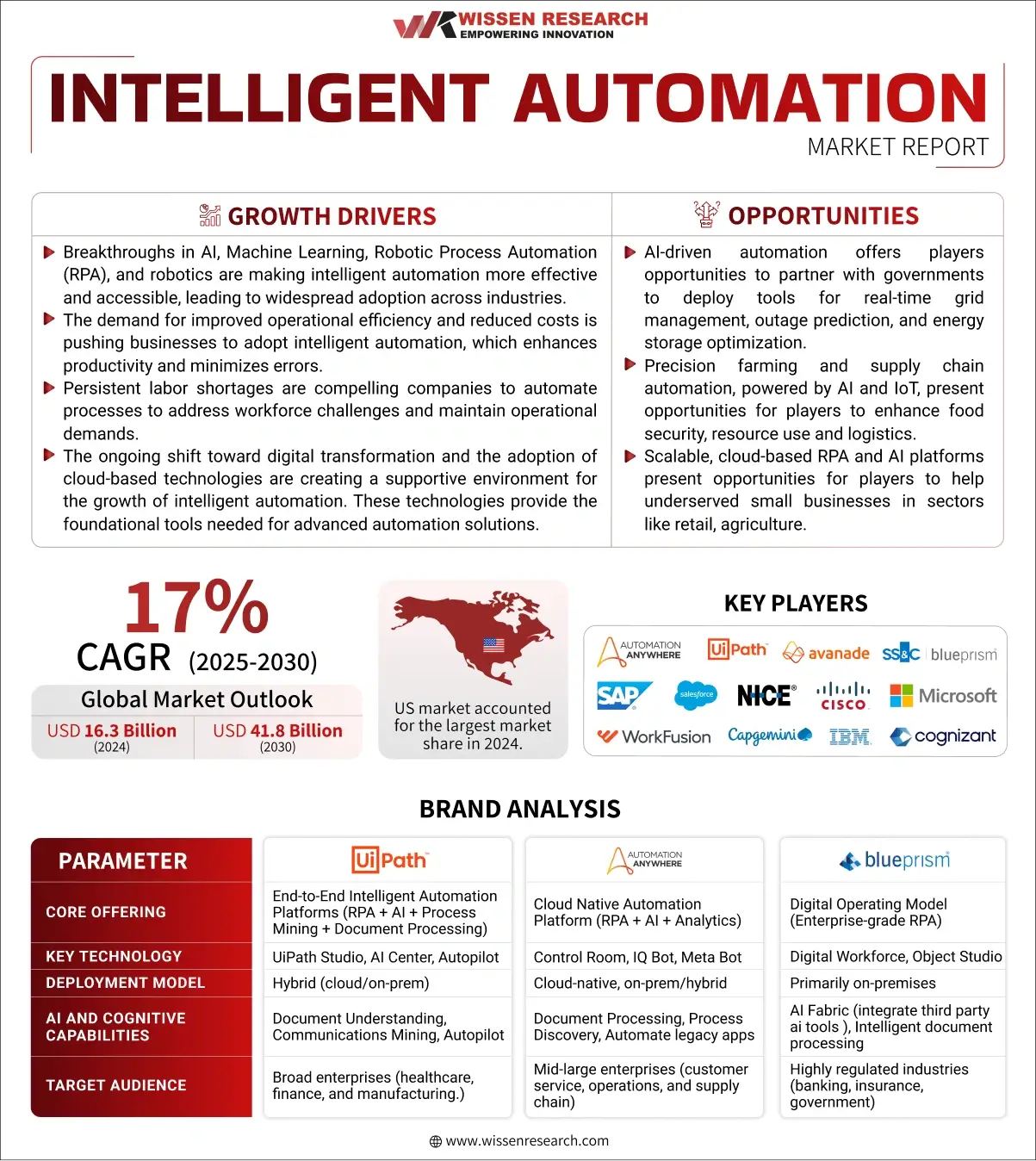
Wissen Research analyzed that the global intelligent automation market was valued at USD 16.3 billion in 2024 and is projected to reach USD 41.8 billion by 2030, expected to grow at a CAGR of 17% during the forecast period, 2025-2030.
North America is currently the biggest market for this technology, regions like Asia-Pacific and Latin America are growing very fast and represent a huge future opportunity.
Furthermore, the US with USD 6.47 billion market in 2024, held a significant share in the global intelligent automation market and is likely to show the highest growth at a CAGR of 17.5% within this market, during the forecast period (2025-2030).
Global Intelligent Automation market is anticipated to reach USD 41.8 billion by 2030 from USD 16.3 billion in 2024, growing at an annualized rate of 17% during the period, 2025-2030 | North America, led by the US and Canada, is a major and highly developed market for Intelligent Automation. Growth is driven by significant corporate investment in advanced technologies, a strong focus on enhancing operational efficiency, and robust digital infrastructure. Both established enterprises and innovative startups are actively adopting AI and automation solutions across various sectors. | Asia-Pacific In Asia-Pacific, there is a massive hunger for smart, efficient solutions to everyday problems, and this is supercharging the intelligent automation market. The region is not just adopting automation; it is actively building an entire digital ecosystem around it. |
The intelligent automation market is rapidly transforming due to AI, machine learning, and user-friendly software. These advancements make systems powerful and versatile, expanding automation beyond simple tasks into complex areas like decision-making and data analysis. | Global investment in intelligent automation is evolving beyond simple task automation. Companies are now building entire ecosystems that combine AI, machine learning, and process management. This is pushing automation into vital areas like personalized healthcare (analysing patient data for custom treatments), predicting and responding to natural disasters, and managing complex energy grids for a greener future. |
Drivers: Government Push and Private Innovation
Strong government initiatives to accelerate digital transformation, national strategies for technology adoption, and robust public-private partnerships throughout Asia-Pacific are driving the adoption of intelligent automation to address labor shortages and boost economic competitiveness. The intersection of advanced AI, machine learning, and evolving regulatory environments is facilitating the wider deployment of these technologies across industries, stimulating fast market growth.
Opportunities: Asia-Pacific Digital Transformation Fuels Intelligent Automation Demand
The region’s aggressive scaling of digital infrastructure, integration of AI and data analytics, and burgeoning cross-industry partnerships are creating fertile ground for intelligent automation solutions. The leadership in technology adoption within the region, combined with explosive demand for operational efficiency to address labor shortages and rising competition, offers substantial opportunities for both established automation vendors and new entrants in the market.
Challenges: High Implementation Costs and Integration Hurdles Limit Intelligent Automation Adoption
Even with strong demand for efficiency, the intelligent automation market faces persistent challenges including high upfront investment in software, infrastructure, and specialized talent, complex integration with legacy systems, and evolving data privacy regulations. Difficulties in achieving seamless interoperability between different automation tools, along with ongoing maintenance and change management requirements, further complicate large-scale deployment. Cybersecurity vulnerabilities in automated workflows and ethical concerns around AI decision-making add significant barriers to enterprise-wide implementation beyond initial pilot projects.
The global intelligent automation market is experiencing significant growth. This development results from the integration of robotic automation, which manages repetitive tasks, and artificial intelligence, which provides thinking and learning capabilities. This combination is being adopted across businesses of all sizes. The market is already valued at 16.3 billion dollars in 2024 and is expected to grow at a CAGR 17%. This rapid expansion is driven by systems becoming smarter, more user-friendly, and capable of handling more complex tasks. The highest demand is from sectors like banking, healthcare, and manufacturing, where automation aids in cost reduction, error minimization, and process acceleration, such as in loan processing or medical scan analysis. Currently, North America holds the largest market share, leading in innovation. However, the Asia-Pacific region is the fastest-growing, fueled by substantial investments and aggressive digital strategies in nations like China, India, and Japan. Looking forward, the market is set for substantial expansion as regulations are established and systems become more integrated into daily operations.
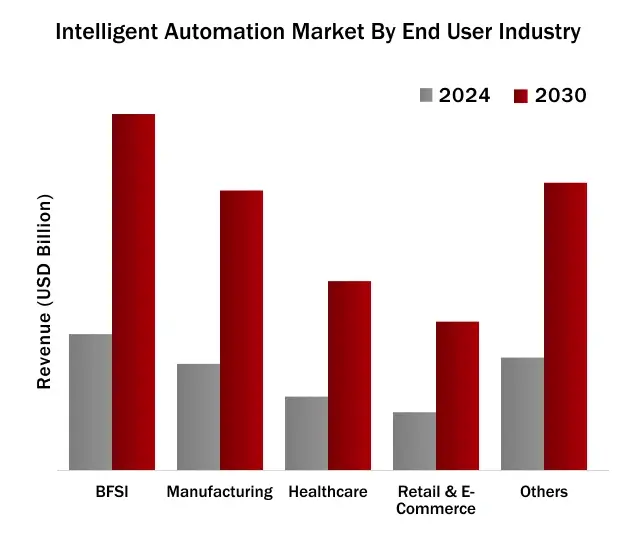
Banking, Financial Services & Insurance (BFSI) Segment Dominated the Intelligent Automation Market by Industrial Vertical in 2024
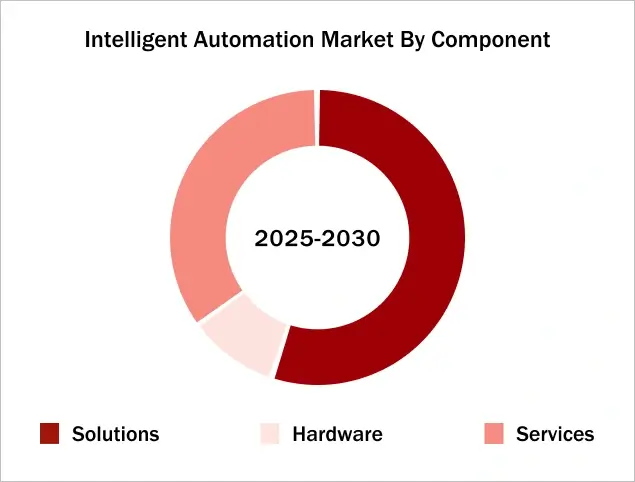
The Solutions segment is projected to hold the largest market share in the intelligent automation market in the forecast period 2025-2030
North America will hold the largest market share in intelligent automation market in the forecast period (2025-2030)
North America is expected to hold the largest market share in the intelligent automation market during the forecast period (2025-2030). This leadership is driven by several key factors. The region is home to a huge concentration of technology companies (like UiPath, Automation Anywhere, Microsoft, and IBM), massive corporate investment in digital transformation, and a strong culture of innovation. Furthermore, the U.S. government has been a major driver, especially in sectors like finance and healthcare, pushing for more efficient and secure processes. The region also has a very advanced and supportive ecosystem of tech partners, consultants, and a skilled workforce, making it the ideal environment for companies to experiment with and scale up their use of intelligent automation.
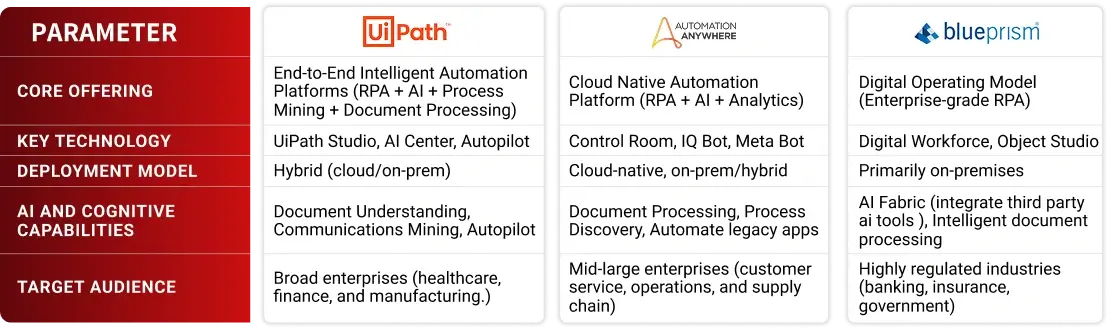
Major players operating in intelligent automation market are:
Sources: Secondary Research
“The rapid adoption of generative AI and digital twins in industrial operations is driving breakthroughs in predictive maintenance, energy optimization, and supply chain resilience.”
CEO – Global Industrial Automation Leader (Europe)
“The convergence of AI-driven analytics and IoT platforms in healthcare is transforming patient monitoring, drug discovery, and administrative workflow efficiency.”
CEO – Pioneering HealthTech Innovator (North America)
“The integration of hyperautomation and RPA in financial services is revolutionizing fraud detection, customer onboarding, and regulatory compliance.”
CEO – FinTech Transformation Specialist (Asia-Pacific)
“The deployment of autonomous AI agents and computer vision in retail logistics is enabling real-time inventory management, last-mile delivery, and personalized customer experiences.”
CEO – E-Commerce Automation Trailblazer (Global)
Sources: Primary Research and Wissen Research Analysis.
Note: Above mention is non-exhaustive samples of the primary insights.
Particulars | Details |
Report | Intelligent Automation Market |
Forecast Period | 2025-2030 |
Base Year | 2024 |
Format | |
Market Size (2024) | USD 16.3 Billion |
CAGR (2025-2030) | 17% |
Number of Pages | 166 |
Number of Tables | 159 |
Number of Figures | 40 |
Key Segments | INTELLIGENT AUTOMATION MARKET BY COMPONENT (Solution, Services, Hardware) INTELLIGENT AUTOMATION MARKET BY ENTERPRISE SIZE (Large, Medium, Small) INTELLIGENT AUTOMATION MARKET BY DEPLOYMENT MODE (Cloud-Based / SaaS, On-Premise, Hybrid) INTELLIGENT AUTOMATION MARKET BY APPLICATION (Customer Service Automations, Supply Chain & Logistics Management, Financial Services Automation, Fraud Detection, Others) INTELLIGENT AUTOMATION MARKET BY END USER INDUSTRY (Banking, Financial Services & Insurance (BFSI), Health Care & Life Sciences, Manufacturing, Retail & E-Commerce, Electrical & Electronics, Automotive, Media & Entertainment, Education, Agriculture, Others) |
Regions Covered | § North America: US and Canada § Europe: Germany, UK, France, Italy, Spain, And Rest of the Europe § Asia-Pacific: China, Japan, India, South Korea, Australia and New Zealand, And Rest of the Asia-Pacific § Latin America § Middle East and Africa |
Key Players Covered (Majority Share Holders) | Automation Anywhere, Inc. (US), UiPath, Inc. (US), IBM (US), SS&C Blue Prism Limited (UK), SAP SE (Germany), Salesforce, Inc. (US), Nice Ltd. (Israel), Microsoft Corporation (US), Work fusion, Inc. (US), Capgemini (France), Cisco System Inc (US), Ernst & Young Global Limited (UK), Cognizant Technology Solution Corporation (US), Avanade Inc. (US) |
Other Players | Accenture PLC (Ireland), CGI Inc. (Canada), NTT Data Inc. (Japan), Software GmBH (Germany), Redwood Software (US) |
1. INTRODUCTION
1.1. KEY OBJECTIVES
1.2. DEFINITIONS
1.2.1. IN SCOPE
1.2.2. OUT OF SCOPE
1.3. SCOPE OF THE REPORT
1.4. SCOPE RELATED LIMITATIONS
1.5. KEY STAKEHOLDERS
2. RESEARCH METHODOLOGY
2.1. RESEARCH APPROACH
2.2. RESEARCH METHODOLOGY / DESIGN
2.3. MARKET SIZE ESTIMATION APPROACHES
2.3.1. SECONDARY RESEARCH
2.3.2. PRIMARY RESEARCH
1.1.1 KEY INSIGHTS FROM INDUSTRY EXPERTS
2.4. DATA VALIDATION & TRIANGULATION
2.5. ASSUMPTIONS OF THE STUDY
3. EXECUTIVE SUMMARY & PREMIUM CONTENT
3.1. GLOBAL MARKET OUTLOOK
3.2. KEY MARKET FINDINGS
4. MARKET OVERVIEW
4.1. INTELLIGENT AUTOMATION MARKET: OVERVIEW
4.1.1. INTRODUCTION
4.2. MARKET DYNAMICS AND DEMAND PROJECTION IN USD, TILL 2030
4.2.1. MARKET DRIVERS
4.2.2. MARKET OPPORTUNITIES
4.2.3. RESTRAINTS/CHALLENGES
4.3. END USER PERCEPTION
4.4. RECENT DEVELOPMENT AND TRENDS
4.5. NEED GAP ANALYSIS
4.6. PRICING ANALYSIS
4.7. KEY CONFERENCES
4.8. SUPPLY CHAIN / VALUE CHAIN ANALYSIS
4.9. INDUSTRY TRENDS
4.10. PORTER’S FIVE FORCES ANALYSIS
4.11. REGULATORY LANDSCAPE
4.11.1. NORTH AMERICA
4.11.2. EUROPE
4.11.3. ASIA PACIFIC
5. PATENT ANALYSIS
5.1. TOP ASSIGNEES
5.2. GEOGRAPHY FOCUS OF TOP ASSIGNEES
5.3. LEGAL STATUS
5.4. TECHNOLOGY EVOLUTION
5.5. KEY PATENTS
5.6. PATENT TRENDS AND INNOVATIONS
6. INTELLIGENT AUTOMATION MARKET, BY COMPONENT (2024-2030, USD MILLION)
6.1. SOLUTIONS
6.1.1.ROBOTIC PROCESS AUTOMATION (RPA)
6.1.2.ARTIFICIAL INTELLIGENCE (AI) & MACHINE LEARNING (ML) PLATFORMS
6.1.3.NATURAL LANGUAGE PROCESSING (NLP)
6.1.4.OPTICAL CHARACTER RECOGNITION (OCR) & INTELLIGENT DOCUMENT PROCESSING (IDP)
6.1.5.BUSINESS PROCESS MANAGEMENT (BPM)
6.1.6.PROCESS MINING & DISCOVERY
6.1.7.INTEGRATION PLATFORMS (IPAAS/DPAAS)
6.1.8.HYPER AUTOMATION PLATFORMS
6.1.9.CHATBOTS & VIRTUAL ASSISTANTS
6.1.10. COGNITIVE SEARCH
6.2. SERVICES
6.2.1.PROFESSIONAL SERVICES
6.2.2.MANAGED SERVICES
6.3. HARDWARE
6.3.1.SERVERS
6.3.2.SPECIALIZED AI/ML HARDWARE
6.3.3.ROBOTICS HARDWARE
7. INTELLIGENT AUTOMATION MARKET, BY ENTERPRISE SIZE (2024-2030, USD MILLION)
7.1. LARGE SIZE SENTERPRISE
7.2. MEDIUM SIZE ENTERPRISE
7.3. SMALL SIZE ENTERPRISE
8. INTELLIGENT AUTOMATION MARKET, BY DEPLOYMENT MODE (2024-2030, USD MILLION
8.1. CLOUD-BASED / SOFTWARE-AS-A-SERVICE (SAAS)
8.2. ON-PRIMISE
8.3. HYBRID
9. INTELLIGENT AUTOMATION MARKET, BY APPLICATION (2024-2030, USD MILLION)
9.1. CUSTOMER SERVICE AUTOMATIONS
9.2. SUPPLY CHAIN & LOGISTICS MANAGEMENT
9.3. FINANCIAL SERVICES AUTOMATION
9.4. FRAUD DETECTION
9.5. OTHERS
10. INTELLIGENT AUTOMATION MARKET, BY END USER INDUSTRY (2024-2030, USD MILLION)
10.1. BANKING, FINANCIAL SERVICES & INSURANCE (BFSI)
10.2. HEALTH CARE & LIFE SCIENCES
10.3. MANUFACTURING
10.4. RETAIL & E-COMMERCE
10.5. ELECTRICAL & ELECTRONICS
10.6. AUTOMOTIVE
10.7. MEDIA &ENTERTAINMENT
10.8. EDUCATION
10.9. OTHERS
11. INTELLIGENT AUTOMATION MARKET, BY REGION (2024-2030, USD MILLION)
11.1. NORTH AMERICA
11.1.1. US
11.1.2. CANADA
11.2. EUROPE
11.2.1. GERMANY
11.2.2. FRANCE
11.2.3. SPAIN
11.2.4. ITALY
11.2.5. UK
11.2.6. REST OF THE EUROPE
11.3. ASIA-PACIFIC
11.3.1. CHINA
11.3.2. JAPAN
11.3.3. INDIA
11.3.4. AUSTRALIA AND NEW ZEALAND
11.3.5. SOUTH KOREA
11.3.6. REST OF THE ASIA-PACIFIC
11.4. MIDDLE EAST AND AFRICA
11.5. LATIN AMERICA
12. COMPETITIVE ANALYSIS
12.1. REVENUE ANALYSIS
12.2. KEY PLAYERS FOOTPRINT ANALYSIS
12.3. MARKET SHARE ANALYSIS (2023/2024)
12.4. REGIONAL SNAPSHOT OF KEY PLAYERS
12.5. R&D EXPENDITURE OF KEY PLAYERS
12.6. BRAND/ PRODUCT COMPARISON
13. COMPANY PROFILES
13.1. UIPATH, INC. (US)
13.1.1. BUSINESS OVERVIEW
13.1.2. PRODUCT PORTFOLIO
13.1.3. FINANCIAL SNAPSHOT
13.1.4. RECENT DEVELOPMENTS
1.1.1 MERGER/ACQUISITIONS
2.1.1 PRODUCT APPROVAL/LAUNCHES
3.1.1 PARTNERSHIP/COLLABORATIONS/AGREEMENTS
4.1.1 EXPANSIONS
13.2. AUTOMATION ANYWHERE, INC. (US)
13.3. IBM (US)
13.4. SS&C BLUE PRISM LIMITED (UK)
13.5. SAP SE (GERMANY)
13.6. SALESFORCE, INC. (US)
13.7. NICE LTD. (ISRAEL)
13.8. MICROSOFT CORPORATION (US)
13.9. WORKFUSION, INC. (US)
13.10. CAPGEMINI (FRANCE)
13.11. CISCO SYSTEM INC (US)
13.12. ERNST & YOUNG GLOBAL LIMITED (UK)
13.13. COGNIZANT TECHNOLOGY SOLUTION CORPORATION (US)
13.14. AVANADE INC. (US)
13.15. OTHER PLAYERS
13.15.1. ACCENTURE PLC (IRELAND)
13.15.2. CGI INC.(CANADA)
13.15.3. NTT DATA INC. (JAPAN)
13.15.4. SOFTWARE GMBH (GERMANY)
13.15.5. REDWOOD SOFTWARE (US)
14. APPENDIX
14.1. INDUSTRY SPEAK
14.2. QUESTIONNAIRE/DISCUSSION GUIDE
14.3. AVAILABLE CUSTOM WORK
14.4. ADJACENT STUDIES
14.5. AUTHORS
15. REFERENCE
The Intelligent Automation industry focuses on developing software and systems capable of performing tasks that typically require human cognitive abilities. This involves integrating automation technologies, which handle repetitive processes, with artificial intelligence capabilities, such as learning, language comprehension, and decision-making. These systems are utilized across various sectors, including large corporations and government bodies, to enhance operational efficiency and accuracy. Applications include processing invoices, managing customer service interactions, analyzing data for predictive insights, and overseeing complex business workflows. Recent advancements in AI and related technologies have significantly increased the capabilities and usability of these systems. The market is characterized by rapid innovation and competition among major technology firms and emerging startups. As more industries recognize the value of these tools, the market continues to expand, enabling businesses to improve efficiency and adopt more data-driven decision-making processes.
FIGURE: INTELLIGENT AUTOMATION MARKET SEGMENTS
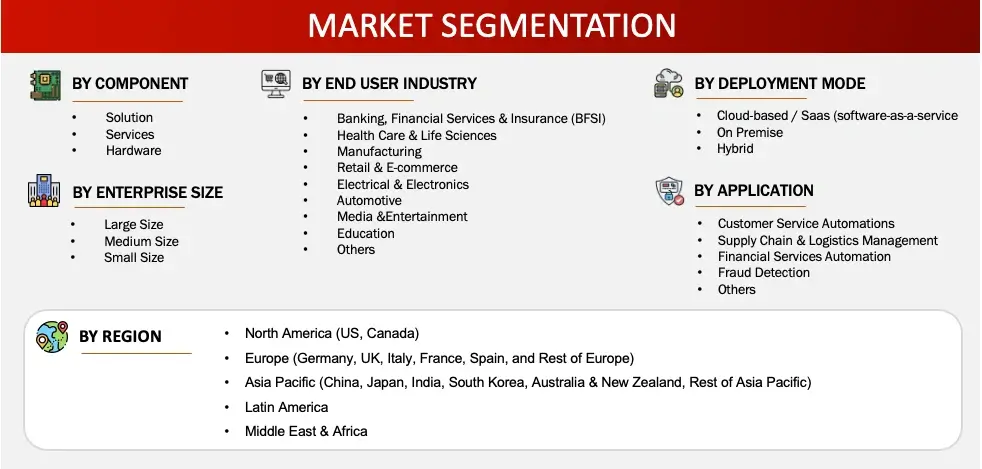
Sources: Company Websites and Wissen Research Analysis
Key Stakeholders
Key Study Objectives
Research Methodology
The objective of the study is to analyze the key market dynamics such as drivers, opportunities, challenges, restraints, and key player strategies. To track company developments such as product launches and approvals, expansions, and collaborations of the leading players, the competitive landscape of the intelligent automation market to analyze market players on various parameters within the broad categories of business and product strategy. Top-down and bottom-up approaches will be used to estimate the market size. To estimate the market size of segments and sub segments the market breakdown and data triangulation will be used.
FIGURE: RESEARCH DESIGN

Sources: Wissen Research Analysis
Research Approach
Collecting Secondary Data
The secondary research data collection process involves the usage of secondary sources, directories, databases, annual reports, investor presentations, and SEC filings of companies. Secondary research will be used to identify and collect information useful for the extensive, technical, market-oriented, and commercial study of the intelligent automation technology market. A database of the key industry leaders will also be prepared using secondary research.
Collecting Primary Data
The primary research data will be conducted after acquiring knowledge about the intelligent automation market scenario through secondary research. A significant number of primary interviews will be conducted with stakeholders from both the demand side and supply side (including various industry experts, such as Directors, Chief X Officers (CXOs), Vice Presidents (VPs) from business development, marketing and product development teams, product manufacturers) across major countries of North America, Europe, Asia Pacific, and Rest of the World. Primary data for this report was collected through questionnaires, emails, and telephonic interviews.
Market Size Estimation
All major manufacturers offering various intelligent automation will be identified at the global/regional level. Revenue mapping will be done for the major players, which will further be extrapolated to arrive at the global market value of each type of segment. The market value of intelligent automation market will also split into various segments and sub segments at the region level based on:
Research Design
After arriving at the overall market size-using the market size estimation processes-the market will be split into several segments and sub segment. To complete the overall market engineering process and arrive at the exact statistics of each market segment and sub segment, the data triangulation, and market breakdown procedures will be employed, wherever applicable. The data will be triangulated by studying various factors and trends from both the demand and supply sides in the intelligent automation market industry.