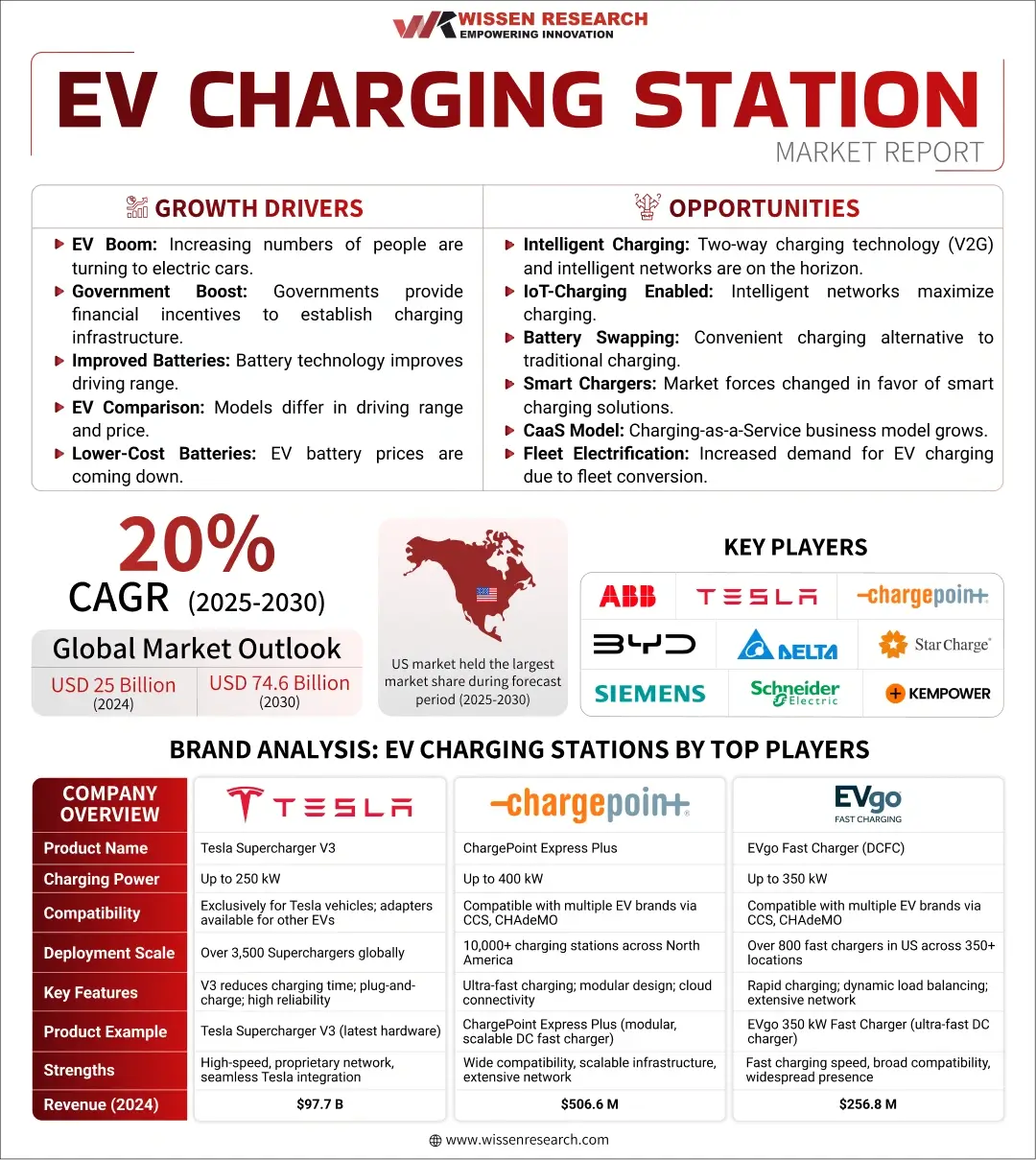
Wissen Research analysed that the global EV Charging Station market was valued at USD 25 billion in 2024 and is projected to reach USD 74.6 billion by 2030, expected to grow at a CAGR of 20% during the forecast period, 2025-2030.
Key Players and Strategies
Market Trends and Opportunities
Furthermore, the US with USD 5 billion market in 2024, held a significant share in the global EV Charging Station market and is likely to grow at a CAGR of 20% within this market, during the forecast period (2025-2030).
Global EV Charging Station market is anticipated to reach USD 74.6 billion by 2030 from USD 25 billion in 2024, growing at an annualized rate of 20% during the period, 2025-2030 | East Asia, led by China, dominates the global EV charging market, driven by government incentives, rising EV adoption, and investments in charging infrastructure, with the region expected to account for a significant share of global installations. | North America and Europe lead in innovative charging solutions, developing high-power charging technologies and integrating renewable energy sources, while Asia-Pacific drives market growth with large-scale deployments. |
The market for EV charging stations is being transformed by advancements in fast-charging technologies, smart grid integration, and renewable energy solutions, enabling efficient and sustainable charging experiences. | DC Fast Charging enables rapid recharging and reduces range anxiety, while smart charging platforms offer real-time monitoring and optimization. Major challenges include high installation costs, grid integration complexity, and need for standardized protocols and interoperable payment systems. |
Drivers: Fostering Reduced Carbon Footprint and Operating Expenses
The EV charging station market contributes to a growth boom as governments, businesses, and consumers ramp up the use of renewable energy-based electric vehicles to curtail carbon emissions and operating expenses. Improved fast-charging technologies, grid connectivity with smart grids, and renewable power solutions are enhancing EV charging efficiency, sustainability, and convenience. Increasing demand for DC Fast Charging and city-center charging hubs is propelling high-power charging infrastructure investment.
Opportunities: Unlocking Growth in Emerging EV Markets and Urban Hubs
Government support, falling battery prices, and increasing environmental consciousness are opening up new avenues for EV charging infrastructure development in Asia-Pacific and other emerging markets. Cloud-based charging management, subscription-based charging plans, and mobility solutions integrated by technology are highlighting new business models, while sustainability needs and urbanization are driving adoption within cities and metropolitan areas.
Challenges: Infrastructure, Interoperability, and User Experience
Technological standards, high initial expenditure, integration into the grid, and necessity for standardized charging procedures still prove to be issues regarding mass uptake. Interoperability across charging networks, easy payment interfaces, and data security issues must also be overcome. Variability of regional charging infrastructure, regulation, and their conformities with market realities complicate deployment and scalability, necessitating addressed market strategies.
The international EV charging infrastructure market, covering all kinds of charging solutions for electric cars, is growing rapidly as governments, businesses, and citizens increasingly use EVs to lower carbon footprints and costs of operation. Valued at USD 25 billion in 2024, the charging infrastructure market is likely to grow to USD 74.6 billion by 2030, at a CAGR of 20%. The key drivers of growth are huge investments in the development of charging infrastructure, increasing adoption of EVs, and improving fast-charging technology. The Asia-Pacific region leads the market with China at the forefront driven by robust government regulations and fast urban electrification, followed by Europe and North America, where it is driven by aggressive emission regulations and investments in smart charging technology. Its growth is further driven by advancements in DC Fast Charging, intelligent charging platforms, and renewable energy integration, enabling EV charging to become more efficient, sustainable, and affordable.
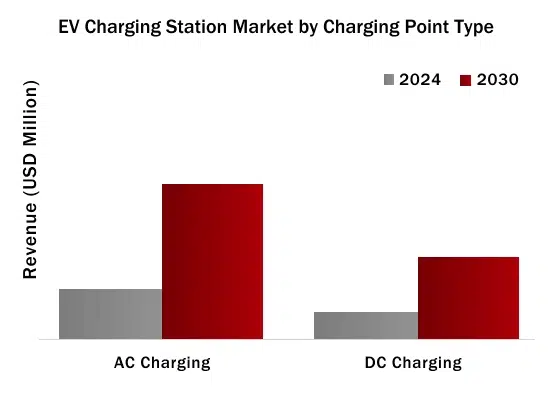
AC Charging segment dominated the EV Charging Station Market by Charging Point Type in 2024
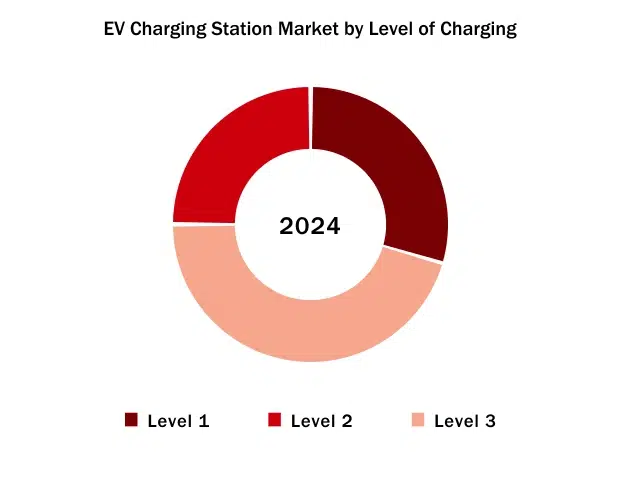
Level 2 Segment held the largest market share in 2024, accounting for a significant market share in EV Charging Station market by Level of Charging
Asia-Pacific held the largest market share in EV Charging Station Market in the forecast period (2025-2030)
The Asia-Pacific region leads the EV charging station market due to:
For example, China’s government has expanded public and private charging networks, making it the largest market for EVs and charging stations. Similarly, companies like VinFast are partnering to roll out extensive charging infrastructure in countries like Indonesia.
Major players operating in EV charging station market are:
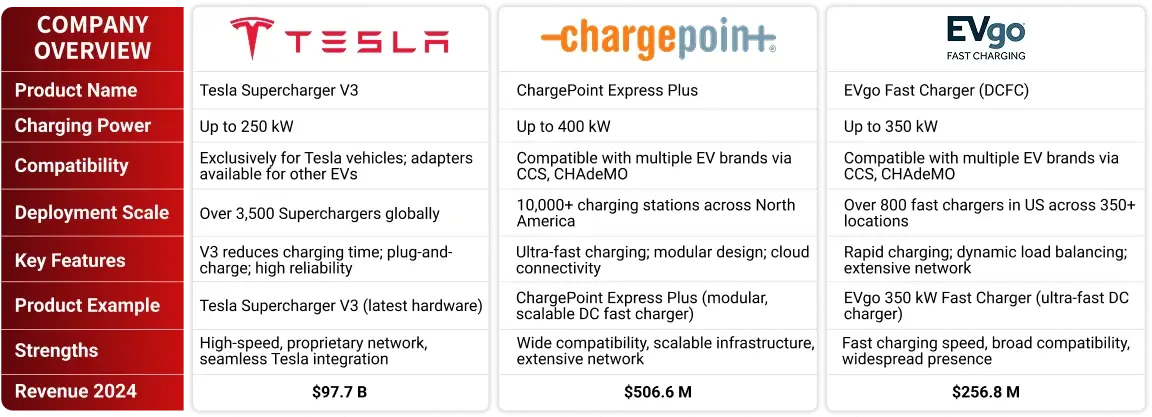
Note: The revenues were collected from company annual reports and sec fillings.
Sources: Secondary Research
“The widespread adoption of fast-charging technology is critical to alleviating range anxiety and driving mass market acceptance of electric vehicles, and companies that invest in high-power charging infrastructure will reap significant rewards.”
Director of Electric Vehicle Infrastructure – Leading Energy Company (North America)
“As governments implement stricter emissions regulations, the demand for public EV charging stations is skyrocketing, and charge point operators who prioritize smart charging solutions and grid resilience will be best positioned for success.”
Head of EV Charging Solutions – Top Charge Point Operator (Europe)
“The integration of renewable energy sources with EV charging infrastructure is a game-changer, enabling charging station operators to reduce their carbon footprint and capitalize on emerging market opportunities.”
Chief Sustainability Officer – EV Charging Infrastructure Provider (Asia-Pacific)
“The development of interoperable payment systems and seamless user experiences will be crucial to driving widespread adoption of EV charging services, and companies that prioritize customer convenience will gain a competitive edge in this rapidly evolving market.”
Vice President of Product Development – EV Charging Network Operator (North America)
Sources: Primary Research and Wissen Research Analysis.
Note: Above mention is non-exhaustive samples of the primary insights.
Particulars | Details |
Report | EV Charging Station Market |
Forecast Period | 2025-2030 |
Base Year | 2024 |
Format | |
Market Size (2024) | USD 25 Billion |
CAGR (2025-2030) | 20% |
Number of Pages | 165 |
Number of Tables | 155 |
Number of Figures | 34 |
Key Segments | EV Charging Station Market by Application (Private, Semi-public, Public) EV Charging Station Market by Charge Point Operator (Asia Pacific: Charge Point Operators, Europe: Charge Point Operators, North America: Charge Point Operators) EV Charging Station Market by Charging Infrastructure Type (Type 1, Type 2, Chademo, CCS, NACS/Tesla SC (Tesla Supercharger), GB/T Fast) EV Charging Station Market by Charging Point Type (AC Charging, DC Charging) EV Charging Station Market by Charging Service Type (EV Charging Services, Battery Swapping Service) EV Charging Station Market by Connection Phase (Single Phase, Three Phase) EV Charging Station Market by DC Fast Charging Type (Slow DC, Fast DC, DC Ultrafast 1, DC Ultrafast 2) EV Charging Station Market by Electric Bus Charging Type (Off-Board Top-Down Pantographs, On-board Bottom-Up Pantographs, Charging Via Connectors) EV Charging Station Market by Installation Type (Portable Chargers, Fixed Charges) EV Charging Station Market by Mode (Mode 1, Mode 2, Mode 3, Mode 4) EV Charging Station Market by Level of Charging (Level 1, Level 2, Level 3) |
Regions Covered | § North America: US and Canada § Europe: Germany, UK, France, Italy, Spain, and Rest of the Europe § Asia-Pacific: China, Japan, India, South Korea, Australia and New Zealand, and Rest of the Asia-Pacific § Latin America § Middle East and Africa |
Key Players Covered (Majority Share Holders) | ABB (Switzerland), BYD Company Ltd. (China), Chargepoint, Inc. (US), Tesla (US), EV Box (Netherlands), Delta Electronics (Taiwan), Starcharge (China), Siemens (Germany), Schneider Electric (France), Kenpower OYJ (Finland), EFACEC (Portugal) |
Other Players | Blink Charging CO. (US), Enphase Energy (US), Electrify America (US), OP Connect (US), EV Safe Charge INC. (US), Ionity (Germany), Wallbox (Spain), Spark Horizon (Singapore), DBT (France), Charge+ (Singapore), Alfen NV (Netherlands), IES Synergy (France), Madic Group (France), BEEV (France), Instavolt (UK), Freshmile (France), Pod Point (UK), BE Charge (Italy), MER (Norway), ENBW (Germany), RWE (Germany), Powerdot (Portugal), Sparkcharge (US), Jolt (Germany), Installer (US), Numbat (Germany), Itselectric Inc (US) |
1. INTRODUCTION
1.1. KEY OBJECTIVES
1.2. DEFINITIONS
1.2.1. IN SCOPE
1.2.2. OUT OF SCOPE
1.3. SCOPE OF THE REPORT
1.4. SCOPE RELATED LIMITATIONS
1.5. KEY STAKEHOLDERS
2. RESEARCH METHODOLOGY
2.1. RESEARCH APPROACH
2.2. RESEARCH METHODOLOGY / DESIGN
2.3. MARKET SIZE ESTIMATION APPROACHES
2.3.1. SECONDARY RESEARCH
2.3.2. PRIMARY RESEARCH
2.3.2.1. KEY INSIGHTS FROM INDUSTRY EXPERTS
2.4. DATA VALIDATION & TRIANGULATION
2.5. ASSUMPTIONS OF THE STUDY
3. EXECUTIVE SUMMARY & PREMIUM CONTENT
3.1. GLOBAL MARKET OUTLOOK
3.2. KEY MARKET FINDINGS
4. MARKET OVERVIEW
4.1. EV CHARGING STATION: OVERVIEW
4.1.1. INTRODUCTION
4.1.2.KEY FEATURES AND FUNCTIONALITIES
4.1.3.BENEFITS OF EV CHARGING STATION
4.1.4.TYPES OF EV CHARGING STATION
4.2. MARKET DYNAMICS
4.2.1. MARKET DRIVERS
4.2.2. MARKET OPPORTUNITIES
4.2.3. RESTRAINTS/CHALLENGES
4.3. END USER PERCEPTION
4.4. NEED GAP ANALYSIS
4.5. SUPPLY CHAIN / VALUE CHAIN ANALYSIS
4.6. INDUSTRY TRENDS
4.7. PORTER’S FIVE FORCES ANALYSIS
4.8. REGULATORY LANDSCAPE
4.8.1.NORTH AMERICA
4.8.2.EUROPE
4.8.3.ASIA PACIFIC
5. PATENT ANALYSIS
5.1. TOP ASSIGNEES
5.2. GEOGRAPHY FOCUS OF TOP ASSIGNEES
5.3. LEGAL STATUS
5.4. TECHNOLOGY EVOLUTION
5.5. KEY PATENTS
5.6. PATENT TRENDS AND INNOVATIONS
6. GLOBAL EV CHARGING STATION MARKET, BY APPLICATION (2025-2030, USD MILLION)
6.1. PRIVATE
6.2. SEMI-PUBLIC
6.3. PUBLIC
7. GLOBAL EV CHARGING STATION MARKET, BY CHARGE POINT OPERATOR (2025-2030, USD MILLION)
7.1. ASIA PACIFIC: CHARGE POINT OPERATORS
7.1.1.CHINA
7.1.2.INDIA
7.1.3.JAPAN
7.1.4.SOUTH KOREA
7.2. EUROPE: CHARGE POINT OPERATORS
7.2.1.GERMANY
7.2.2.FRANCE
7.2.3.UK
7.2.4.DENMARK
7.2.5.NETHERLANDS
7.2.6.NORWAY
7.2.7.SWITZERLAND
7.2.8.SPAIN
7.3. NORTH AMERICA: CHARGE POINT OPERATORS
7.3.1.US
7.3.2.CANADA
8. GLOBAL EV CHARGING STATION MARKET, BY CHARGING INFRASTRUCTURE TYPE (2025-2030, USD MILLION)
8.1. TYPE 1
8.2. TYPE 2
8.3. CHADEMO
8.4. CCS
8.5. NACS/TESLA SC (TESLA SUPERCHARGER)
8.6. GB/T FAST
9. GLOBAL EV CHARGING STATION MARKET, BY CHARGING POINT TYPE (2025-2030, USD MILLION)
9.1. AC CHARGING
9.2. DC CHARGING
10. GLOBAL EV CHARGING STATION MARKET, BY CHARGING SERVICE TYPE (2025-2030, USD MILLION)
10.1. EV CHARGING SERVICES
10.2. BATTERY SWAPPING SERVICE
11. GLOBAL EV CHARGING STATION MARKET, BY CONNECTION PHASE (2025-2030, USD MILLION)
11.1. SINGLE PHASE
11.2. THREE PHASE
12. GLOBAL EV CHARGING STATION MARKET, BY DC FAST CHARGING TYPE (2025-2030, USD MILLION)
12.1. SLOW DC
12.2. FAST DC
12.3. DC ULTRAFAST 1
12.4. DC ULTRAFAST 2
12.4.1. 400 KW
12.4.2. MEGAWATT CHARGING SYSTEMS
13. GLOBAL EV CHARGING STATION MARKET, BY ELECTRIC BUS CHARGING TYPE (2025-2030, USD MILLION)
13.1. OFF-BOARD TOP-DOWN PANTOGRAPHS
13.2. ONBOARD BOTTOM-UP PANTOGRAPHS
13.3. CHARGING VIA CONNECTORS
14. GLOBAL EV CHARGING STATION MARKET, BY INSTALLATION TYPE (2025-2030, USD MILLION)
14.1. PORTABLE CHARGERS
14.2. FIXED CHARGES
15. GLOBAL EV CHARGING STATION MARKET, BY LEVEL OF CHARGING (2025-2030, USD MILLION)
15.1. LEVEL 1
15.2. LEVEL 2
15.3. LEVEL 3
16. GLOBAL EV CHARGING STATION MARKET, BY MODE (2025-2030, USD MILLION)
16.1. MODE 1
16.2. MODE 2
16.3. MODE 3
16.4. MODE 4
17. GLOBAL EV CHARGING STATION MARKET, BY REGION (2025-2030, USD MILLION)
17.1. NORTH AMERICA
17.1.1. US
17.1.2. CANADA
17.2. EUROPE
17.2.1. GERMANY
17.2.2. FRANCE
17.2.3. SPAIN
17.2.4. ITALY
17.2.5. UK
17.2.6. REST OF THE EUROPE
17.3. ASIA-PACIFIC
17.3.1. CHINA
17.3.2. JAPAN
17.3.3. INDIA
17.3.4. AUSTRALIA AND NEW ZEALAND
17.3.5. SOUTH KOREA
17.3.6. REST OF THE ASIA-PACIFIC
17.4. MIDDLE EAST AND AFRICA
17.5. LATIN AMERICA
18. COMPETITIVE ANALYSIS
18.1. PRODUCT PIPELINE: EV CHARGING STATION
18.2. KEY PLAYERS FOOTPRINT ANALYSIS
18.3. MARKET SHARE ANALYSIS (2023/2024)
18.4. REGIONAL SNAPSHOT OF KEY PLAYERS
18.5. R&D EXPENDITURE OF KEY PLAYERS
19. COMPANY PROFILES
19.1. ABB (Switzerland)
19.1.1. BUSINESS OVERVIEW
19.1.2. PRODUCT PORTFOLIO
19.1.3. FINANCIAL SNAPSHOT
19.1.4. RECENT DEVELOPMENTS
19.1.4.1. MERGER/ACQUISITIONS
19.1.4.2. PRODUCT APPROVAL/LAUNCHES
19.1.4.3. PARTNERSHIP/COLLABORATIONS/AGREEMENTS
19.1.4.4. EXPANSIONS
19.2. BYD COMPANY LTD. (China)
19.3. CHARGEPOINT, INC. (US)
19.4. TESLA (US)
19.5. EV BOX (Netherlands)
19.6. DELTA ELECTRONICS (Taiwan)
19.7. STARCHARGE (China)
19.8. SIEMENS (Germany)
19.9. SCHNEIDER ELECTRIC (France)
19.10. KENPOWER OYJ (Finland)
19.11. EFACEC (Portugal)
19.12. OTHER PLAYERS
19.12.1. BLINK CHARGING CO. (US)
19.12.2. ENPHASE ENERGY (US)
19.12.3. ELECTRIFY AMERICA (US)
19.12.4. OPCONNECT (US)
19.12.5. EV SAFE CHARGE INC. (US)
19.12.6. IONITY (Germany)
19.12.7. WALLBOX (Spain)
19.12.8. SPARK HORIZON (Singapore)
19.12.9. DBT (France)
19.12.10. CHARGE+ (Singapore)
19.12.11. ALFEN NV (Netherlands)
19.12.12. IES SYNERGY (France)
19.12.13. MADIC GROUP (France)
19.12.14. BEEV (France)
19.12.15. INSTAVOLT (UK)
19.12.16. FRESHMILE (France)
19.12.17. POD POINT (UK)
19.12.18. BE CHARGE (Italy)
19.12.19. MER (Norway)
19.12.20. ENBW (Germany)
19.12.21. RWE (Germany)
19.12.22. POWERDOT (Portugal)
19.12.23. SPARKCHARGE (US)
19.12.24. JOLT (Germany)
19.12.25. INSTALLER (US)
19.12.26. NUMBAT (Germany)
19.12.27. ITSELECTRIC INC (US)
20. KEY CHARGING POINT OPERATORS
20.1. ENGIE (France)
20.2. SHELL P.L.C (UK)
20.3. TOTALENERGIES (France)
20.4. BP P.L.C (UK)
20.5. ENEL X S.R.L (Italy)
20.6. VIRTA GLOBAL (Finland)
20.7. ALLEGRO B.V. (Netherlands)
20.8. TGOOD ELECTRIC CO. LTD. (China)
20.9. STATE GRID CORPORATION CHINA (China)
20.10. VATTENFALL AB (Sweden)
21. APPENDIX
21.1. INDUSTRY SPEAK
21.2. QUESTIONNAIRE/DISCUSSION GUIDE
21.3. AVAILABLE CUSTOM WORK
21.4. ADJACENT STUDIES
21.5. AUTHORS
22. REFERENCES
The EV Charging Station Market consists of equipment, infrastructure, and services facilitating electric vehicle (EV) charging in commercial, private, and public environments. It entails a variety of charging solutions, including AC and DC fast chargers, networked charging platforms, and smart charging systems, deployed at venues such as urban areas, residential buildings, workplaces, and highways. EV charging stations aim to facilitate increasing adoption of electric mobility through safe, efficient, and reliable delivery of energy to passenger cars, commercial fleets, and public transport. Growth in the market is fostered by increasing adoption of EVs, favorable government policies, innovation in charging speeds and connectivity, and increasing investments in clean transport infrastructure.
FIGURE: EV CHARGING STATION MARKET SEGMENTS
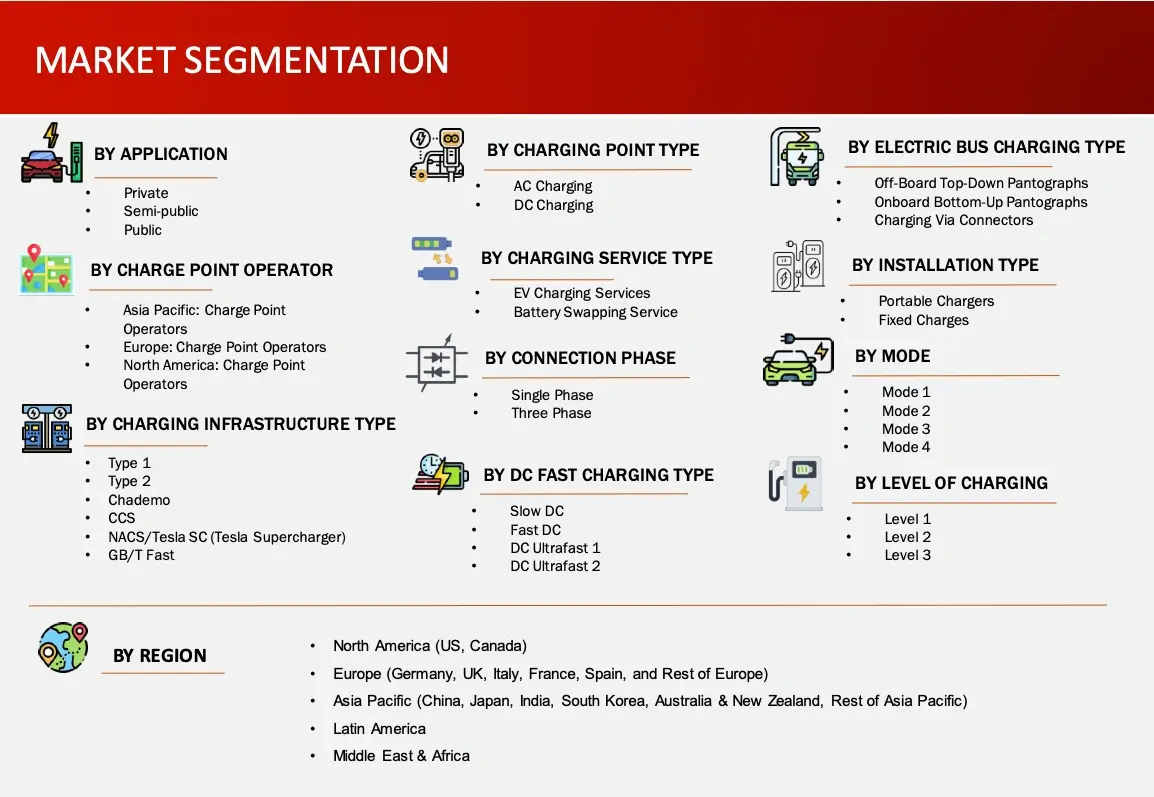
Sources: Company Websites and Wissen Research Analysis
Key Stakeholders
Key Study Objective
Research Methodology
The objective of the study is to analyze the key market dynamics such as drivers, opportunities, challenges, restraints, and key player strategies. To track company developments such as product launches and approvals, expansions, and collaborations of the leading players, the competitive landscape of the EV charging station market to analyze market players on various parameters within the broad categories of business and product strategy. Top-down and bottom-up approaches will be used to estimate the market size. To estimate the market size of segments and sub segments the market breakdown and data triangulation will be used.
FIGURE: RESEARCH DESIGN
Sources: Wissen Research Analysis
Research Approach
Collecting Secondary Data
The secondary research data collection process involves the usage of secondary sources, directories, databases, annual reports, investor presentations, and SEC filings of companies. Secondary research will be used to identify and collect information useful for the extensive, technical, market-oriented, and commercial study of the EV charging station market. A database of the key industry leaders will also be prepared using secondary research.
Collecting Primary Data
The primary research data will be conducted after acquiring knowledge about the EV charging station market scenario through secondary research. A significant number of primary interviews will be conducted with stakeholders from both the demand side and supply side (including various industry experts, such as Directors, Chief X Officers (CXOs), Vice Presidents (VPs) from business development, marketing and product development teams, product manufacturers) across major countries of North America, Europe, Asia Pacific, and Rest of the World. Primary data for this report was collected through questionnaires, emails, and telephonic interviews.
Market Size Estimation
All major developers offering various EV charging station will be identified at the global/regional level. Revenue mapping will be done for the major players, which will further be extrapolated to arrive at the global market value of each type of segment. The market value of EV charging station market will also split into various segments and sub segments at the region level based on:
Research Design
After arriving at the overall market size-using the market size estimation processes-the market will be split into several segments and sub segment. To complete the overall market engineering process and arrive at the exact statistics of each market segment and sub segment, the data triangulation, and market breakdown procedures will be employed, wherever applicable. The data will be triangulated by studying various factors and trends from both the demand and supply sides in the EV charging station industry.