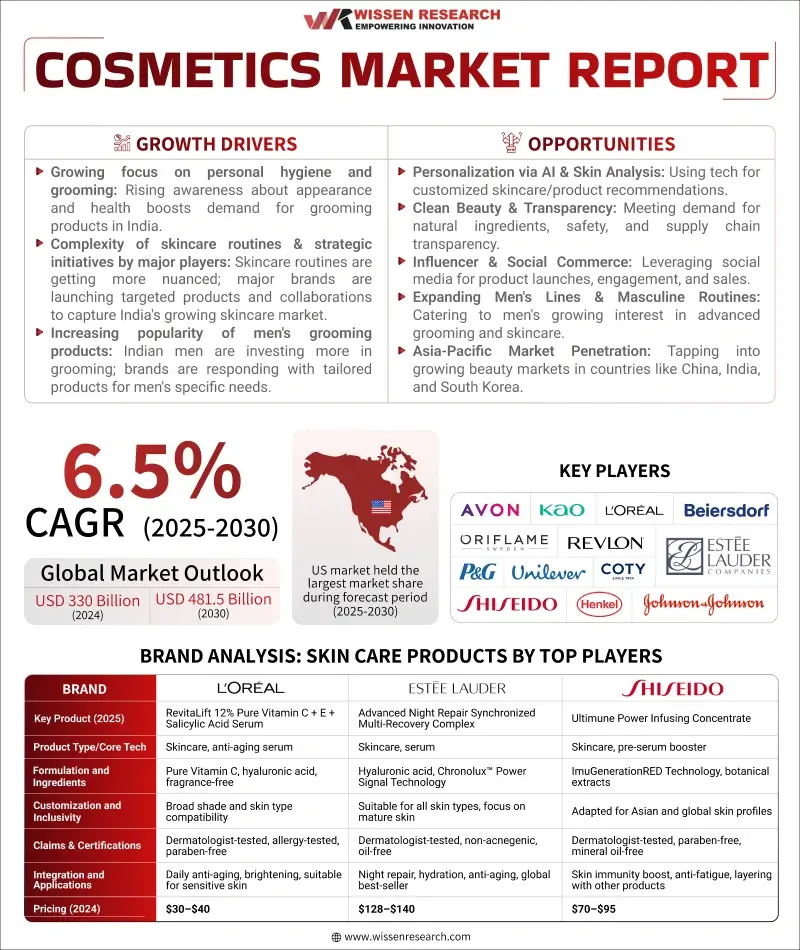
The cosmetics industry is fueled by increasing consumer demand for personal grooming, beauty, self-expression, and products that are now part of everyday routines in skincare, haircare, color cosmetics, and fragrances. Major drivers include the rise of social media, the move toward natural and organic ingredients, health, sustainability, and ethical sourcing awareness. Accelerating product innovation, digital marketing, and growth in e-commerce platforms further drive market growth.
Opportunities within the cosmetics industry come from the growing acceptance of clean and cruelty-free formulations, the emergence of personalized and tech-infused beauty solutions, and the acceleration of demand for sustainable packaging. Broadening applications in men’s grooming, anti-aging, and wellness-oriented products, as well as the growth of niche and indie brands, offer strong growth potential. With changing consumer tastes and stricter regulation, continuous innovation and transparency are likely to open up new opportunities for traditional brands and up-and-coming labels around the world.
Skin & Sun care segment has held the largest share in the market since 2022 till current and is expected to show the highest growth during the forecast period as well, with North America dominating the regional market share.
Furthermore, the US with USD 78 billion market in 2024, held a significant share in the global cosmetics market and is likely to show the highest growth at a CAGR of 6.5% within this market, during the forecast period (2025-2030).
Global cosmetics market is anticipated to reach USD 481.5 billion by 2030 from USD 330 billion in 2024, growing at an annualized rate of 6.5% during the period, 2025-2030 | Asia-Pacific, dominated by China, Japan, South Korea, and India, has become a world powerhouse for cosmetics consumption and innovation. Aggressive R&D investments, increasing disposable incomes, and urbanization growth are propelling the growth of premium, natural, and personalized cosmetics products, making the region the fastest-growing cosmetics market globally. | Asia-Pacific In Asia-Pacific, a growing demand for high-quality, natural, and multifunctional beauty products is driving rapid growth in the cosmetics market. Domestic investments in local production, digital retailing expansion, and influencer marketing are building a strong ecosystem that facilitates both innovation and mass commercial deployment |
The global cosmetics market is witnessing vibrant change as ingredient science, digital interaction, and personalization redefine product development in skincare, haircare, and color cosmetics. This shift is fuelling mass adoption of clean, green, and tech-driven beauty solutions with high traction among wellness- and digital-commerce-focused, inclusive regions. | International investment in beauty tech such as AI-based personalization, biotech-enabled formulations, and eco-packaging is broadening cosmetics usage beyond conventional beauty into wellness, anti-aging, and gender-free categories. For instance, major brands are using AI skin analysis and virtual try-on capabilities to engage consumers and drive product discovery. The direction of the market is influenced by changing regulatory norms, supply chain hurdles in sourcing sustainable ingredients, and growing consumer attention to product safety and performance. Strategic collaborations, first-party marketing, and open labeling are becoming crucial for brands to gain trust and expand across geographies and segments. |
Drivers: Asia-Pacific Urbanization, Digital Influence, and Premiumization Drive Cosmetics Market Growth
Urbanization, increasing disposable incomes, and changing beauty habits in Asia-Pacific are driving demand for premium, natural, and personalized cosmetics. Social media, influencer, and online shopping influences the penetration of products, and innovation in skincare and makeup spurred by R&D and regional requirements continues to fuel strong market growth.
Opportunities: E-commerce Growth and Clean Beauty Trends Open Up Fresh Growth Opportunities
The rapid expansion of e-commerce, livestream selling, and social media-based marketing is opening up new avenues for brands to reach out to different consumer groups, particularly in the emerging Southeast Asian economies. Increased demand for sustainable, organic, and multi-functional beauty products, as well as a growing trend towards male grooming and wellness-oriented products, offers substantial opportunities for incumbent as well as new brands to gain market share and fuel innovation.
Challenges: Intense Competition and Regulatory Complexity Hinder Market Penetration
Even with the robust demand, the cosmetics industry is challenged by stiff competition, diversified retail environments, and high consumer demands for product safety and effectiveness. Navigating through different regulatory norms, ingredient transparency, and supply chain complications particularly in sustainable and clean beauty products pose additional hurdles to massive expansion and brand differentiation throughout the Asia-Pacific region.
The global cosmetics industry, encompassing skincare, haircare, make-up, fragrances, and toiletries, is witnessing strong expansion fueled by increasing consumer interest in personal care, wellness, and self-expression. Worth around USD 351.4 billion in 2025, the industry is estimated to grow to over USD 481.5 billion by 2030 at a CAGR of 6.5%. Key drivers are rising disposable incomes, urbanization, and the impact of social media and e-commerce, which are increasing product availability and influencing beauty trends globally. Asia-Pacific dominates the market, with approximately 40% of world value, driven by rising consumer spending, premiumization, and a rise in demand for natural and customized beauty products. North America and Europe continue to be central, serving as hotspots of innovation, regulatory evolution, and high-end brand takes. The ongoing transition to clean beauty, digital interaction, and omnichannel retailing is likely to drive global cosmetics market growth further over the next few years.
Skin and Sun Care segment dominated the Cosmetics Market by Product Category in 2024

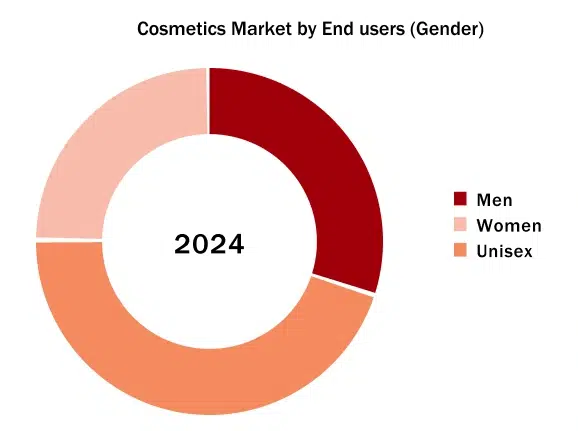
Women’s cosmetics accounted for the largest market share in 2024 in cosmetics market by End User (Gender)
North America held the largest market share in Cosmetics Market in the forecast period (2025-2030)
North America had the majority market share in the cosmetics sector during the forecast period (2025–2030) driven by high consumer demand, high disposable incomes, and high adoption of novel beauty trends. Top companies such as L’Oréal and Estée Lauder have stepped up R&D investments, like L’Oréal’s new $140 million center of innovation in New Jersey, to speed up product launches and green science efforts. The dominance of the region’s market is also supported by the power of social media and celebrity-led promotions, along with the drive towards clean, sustainable, and cruelty-free products, that have led traditional brands to reformulate and openly label their products. The sale of products through the online channel has also been a driving force, where more than a third of the market is captured, allowing brands to serve wider consumers and quickly respond to changing tastes.
Major players operating in Cosmetics market are:
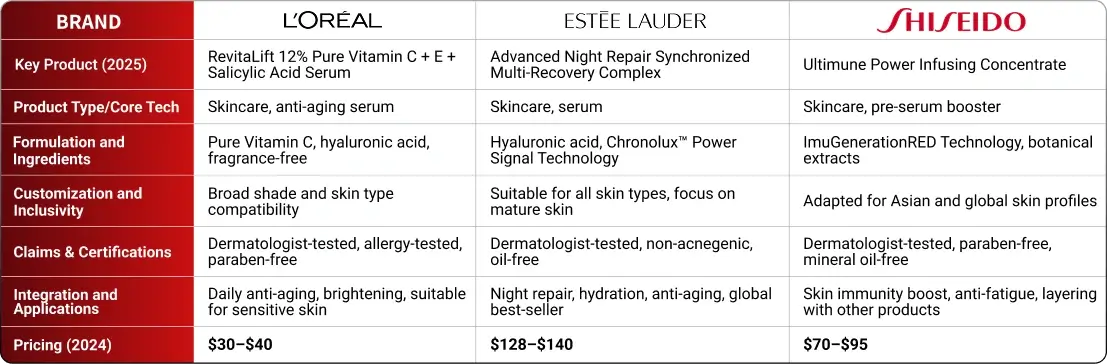
Note: The above pricing has been collected from company websites and third party sellers, latest as of 2024
Sources: Secondary Research
“Consumers are increasingly demanding natural, organic, and “clean” beauty products, with nearly 68% seeking “clean” labels and 55% willing to pay more for sustainable options.”
Chief Marketing Officer – Global Beauty Brand (North America)
“Digital engagement and social commerce are reshaping the market, as brands leverage AI-driven personalization, influencer marketing, and seamless online-to-offline experiences to drive sales and loyalty”
VP, Digital Strategy – Leading Cosmetics Company (Europe)
“Niche, independent, and eco-friendly brands are outpacing legacy players in growth, as consumers prioritize innovation, transparency, and value alignment over traditional brand loyalty.”
Director of Brand Innovation – Indie Skincare Label (Asia-Pacific)
“Sustainability is now a core expectation, with almost 80% of beauty brands prioritizing eco-friendly packaging and ethical sourcing, and refillable or zero-waste solutions gaining mainstream traction.”
Executive Director, Sustainability – Major Cosmetics Manufacturer (North America)
Sources: Primary Research and Wissen Research Analysis.
Note: Above mention is non-exhaustive samples of the primary insights.
Particulars | Details |
Report | Cosmetics Market |
Forecast Period | 2025-2030 |
Base Year | 2024 |
Format | |
Market Size (2024) | USD 330 Billion |
CAGR (2025-2030) | 6.5% |
Number of Pages | 165 |
Number of Tables | 155 |
Number of Figures | 34 |
Key Segments | Cosmetics Market Product Category Outlook (Skin and Sun Care, Hair Care Product, Fragrances, Makeup and Color Cosmetics) Cosmetics Market Distribution Channel Outlook (Hypermarkets/Supermarkets, Specialty Stores, Pharmacies, Online Sales Channel) Cosmetics Market End User (Gender) Outlook (Men, Women, Unisex) |
Regions Covered | § North America: US and Canada § Europe: Germany, UK, France, Italy, Spain, and Rest of the Europe § Asia-Pacific: China, Japan, India, South Korea, Australia and New Zealand, and Rest of the Asia-Pacific § Latin America § Middle East and Africa |
Key Players Covered (Majority Share Holders) | Avon Products, Inc. (US), Kao Corporation (Japan), L’oréal S.A. (France), Oriflame Cosmetics Global S.A. (Switzerland), Revlon, Inc. (US), Shiseido Company, Limited (Japan), Skinfood Co., Ltd. (South Korea), The Estee Lauder Companies Inc. (US), The Procter & Gamble Company (US), Unilever PLC. (UK), Coty Inc. (US), Beiersdorf Ag (Germany), Henkel Ag & Co Kgaa (Germany), Johnson & Johnson (US), Hoyu Co., Ltd. (Japan) |
1. INTRODUCTION
1.1. KEY OBJECTIVES
1.2. DEFINITIONS
1.2.1. IN SCOPE
1.2.2. OUT OF SCOPE
1.3. SCOPE OF THE REPORT
1.4. SCOPE RELATED LIMITATIONS
1.5. KEY STAKEHOLDERS
2. RESEARCH METHODOLOGY
2.1. RESEARCH APPROACH
2.2. RESEARCH METHODOLOGY / DESIGN
2.3. MARKET SIZE ESTIMATION APPROACHES
2.3.1. SECONDARY RESEARCH
2.3.2. PRIMARY RESEARCH
2.3.2.1. KEY INSIGHTS FROM INDUSTRY EXPERTS
2.4. DATA VALIDATION & TRIANGULATION
2.5. ASSUMPTIONS OF THE STUDY
3. EXECUTIVE SUMMARY & PREMIUM CONTENT
3.1. GLOBAL MARKET OUTLOOK
3.2. KEY MARKET FINDINGS
4. MARKET OVERVIEW
4.1. COSMETICS MARKET: OVERVIEW
4.1.1. INTRODUCTION
4.2. MARKET DYNAMICS
4.2.1. MARKET DRIVERS
4.2.2. MARKET OPPORTUNITIES
4.2.3. RESTRAINTS/CHALLENGES
4.3. END USER PERCEPTION
4.4. NEED GAP ANALYSIS
4.5. KEY CONFERENCES
4.6. SUPPLY CHAIN / VALUE CHAIN ANALYSIS
4.7. INDUSTRY TRENDS
4.8. PORTER’S FIVE FORCES ANALYSIS
4.9. REGULATORY LANDSCAPE
4.9.1.NORTH AMERICA
4.9.2.EUROPE
4.9.3.ASIA PACIFIC
5. PATENT ANALYSIS
5.1. TOP ASSIGNEES
5.2. GEOGRAPHY FOCUS OF TOP ASSIGNEES
5.3. LEGAL STATUS
5.4. TECHNOLOGY EVOLUTION
5.5. KEY PATENTS
5.6. PATENT TRENDS AND INNOVATIONS
6. GLOBAL COSMETICS MARKET BY, PRODUCT CATEGORY (2025-2030, USD MILLION)
6.1. SKIN AND SUN CARE
6.2. HAIR CARE PRODUCT
6.3. FRAGRANCES
6.4. MAKEUP AND COLOUR COSMETICS
6.5. OTHERS
7. GLOBAL COSMETICS MARKET BY, END USER (GENDER) (2025-2030, USD MILLION)
7.1. MEN
7.2. WOMEN
7.3. UNISEX
8. GLOBAL COSMETICS MARKET BY, DISTRIUTION CHANNEL (2025-2030, USD MILLION)
8.1. HYPERMARKETS/SUPERMARKETS
8.2. SPECIALTY STORES
8.3. PHARMACIES
8.4. ONLINE SALES CHANNEL
8.5. OTHERS
9. GLOBAL COSMETICS MARKET BY, REGION (2025-2030, USD MILLION)
9.1. NORTH AMERICA
9.1.1. US
9.1.2. CANADA
9.2. EUROPE
9.2.1. GERMANY
9.2.2. FRANCE
9.2.3. SPAIN
9.2.4. ITALY
9.2.5. UK
9.2.6. REST OF THE EUROPE
9.3. ASIA-PACIFIC
9.3.1. CHINA
9.3.2. JAPAN
9.3.3. INDIA
9.3.4. AUSTRALIA AND NEW ZEALAND
9.3.5. SOUTH KOREA
9.3.6. REST OF THE ASIA-PACIFIC
9.4. MIDDLE EAST AND AFRICA
9.5. LATIN AMERICA
10. COMPETITIVE ANALYSIS
10.1. REVENUE ANALYSIS
10.2. KEY PLAYERS FOOTPRINT ANALYSIS
10.3. MARKET SHARE ANALYSIS (2023/2024)
10.4. REGIONAL SNAPSHOT OF KEY PLAYERS
10.5. R&D EXPENDITURE OF KEY PLAYERS
10.6. BRAND/ PRODUCT COMPARISON
11. COMPANY PROFILES
11.1. AVON PRODUCTS, INC (US)
11.1.1. BUSINESS OVERVIEW
11.1.2. PRODUCT PORTFOLIO
11.1.3. FINANCIAL SNAPSHOT
11.1.4. RECENT DEVELOPMENTS
11.1.4.1. MERGER/ACQUISITIONS
11.1.4.2. PRODUCT APPROVAL/LAUNCHES
11.1.4.3. PARTNERSHIP/COLLABORATIONS/AGREEMENTS
11.1.4.4. EXPANSIONS
11.2. KAO CORPORATION (Japan)
11.3. L’ORÉAL S.A. (France)
11.4. JOHNSON & JOHNSON (US)
11.5. ORIFLAME COSMETICS GLOBAL SA (Switzerland)
11.6. REVLON, INC. (US)
11.7. SHISEIDO COMPANY, LIMITED (Japan)
11.8. SKINFOOD CO., LTD. (South Korea)
11.9. THE ESTEE LAUDER COMPANIES INC. (US)
11.10. THE PROCTER & GAMBLE COMPANY (US)
11.11. UNILEVER PLC (UK)
11.12. COTY INC. (US)
11.13. BEIERSDORF AG (Germany)
11.14. HENKEL AG & CO KGAA (Germany)
11.15. HOYU CO., LTD. (Japan)
12. APPENDIX
12.1. INDUSTRY SPEAK
12.2. QUESTIONNAIRE/DISCUSSION GUIDE
12.3. AVAILABLE CUSTOM WORK
12.4. ADJACENT STUDIES
12.5. AUTHORS
13. REFERENCES
The cosmetics industry entails the production, formulation, and sale of items aimed at improving appearance, personal hygiene, and hair and skin health. It encompasses a broad array of products such as skincare, haircare, makeup, perfumes, and toiletries targeting both men and women. Propelled by changing beauty fashions, increasing consumer consciousness, and online power, the industry is defined by constant innovation, sustainability efforts, and fierce competition between international and local brands. With consumer sentiments moving toward natural products and customized solutions, the cosmetics market continues to evolve, providing more product variety and availability through diverse distribution channels.
FIGURE: COSMETICS MARKET SEGMENTS
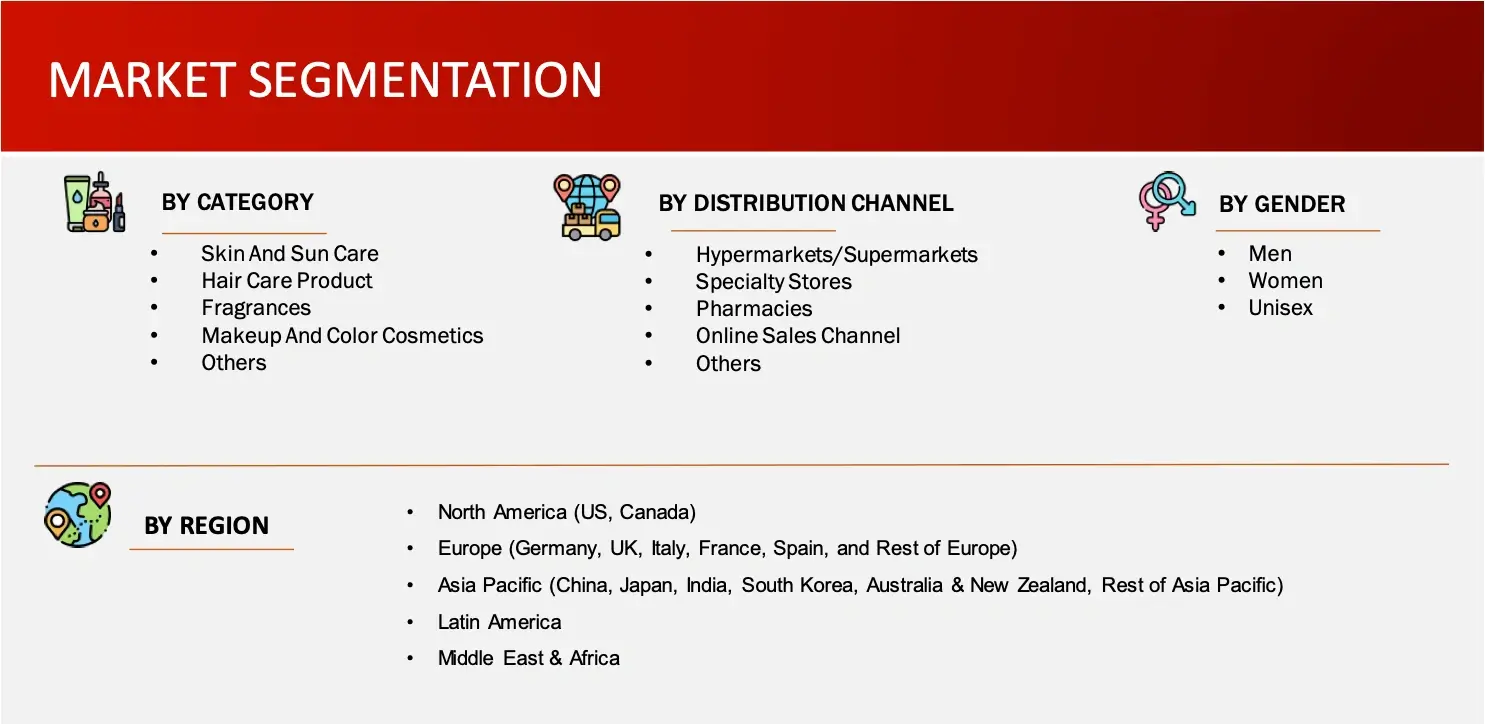
Sources: Company Websites and Wissen Research Analysis
Key Stakeholders
Key Study Objectives
Research Methodology
The objective of the study is to analyze the key market dynamics such as drivers, opportunities, challenges, restraints, and key player strategies. To track company developments such as product launches and approvals, expansions, and collaborations of the leading players, the competitive landscape of the cosmetics market to analyze market players on various parameters within the broad categories of business and product strategy. Top-down and bottom-up approaches will be used to estimate the market size. To estimate the market size of segments and sub segments the market breakdown and data triangulation will be used.
FIGURE: RESEARCH DESIGN

Sources: Wissen Research Analysis
Research Approach
Collecting Secondary Data
The secondary research data collection process involves the usage of secondary sources, directories, databases, annual reports, investor presentations, and SEC filings of companies. Secondary research will be used to identify and collect information useful for the extensive, technical, market-oriented, and commercial study of the cosmetics market. A database of the key industry leaders will also be prepared using secondary research.
Collecting Primary Data
The primary research data will be conducted after acquiring knowledge about the cosmetics market scenario through secondary research. A significant number of primary interviews will be conducted with stakeholders from both the demand side and supply side (including various industry experts, such as Directors, Chief X Officers (CXOs), Vice Presidents (VPs) from business development, marketing and product development teams, product manufacturers) across major countries of North America, Europe, Asia Pacific, and Rest of the World. Primary data for this report was collected through questionnaires, emails, and telephonic interviews.
Market Size Estimation
All major manufacturers offering various cosmetics will be identified at the global/regional level. Revenue mapping will be done for the major players, which will further be extrapolated to arrive at the global market value of each type of segment. The market value of cosmetics market will also split into various segments and sub segments at the region level based on:
Research Design
After arriving at the overall market size-using the market size estimation processes-the market will be split into several segments and sub segment. To complete the overall market engineering process and arrive at the exact statistics of each market segment and sub segment, the data triangulation, and market breakdown procedures will be employed, wherever applicable. The data will be triangulated by studying various factors and trends from both the demand and supply sides in the cosmetics market industry.