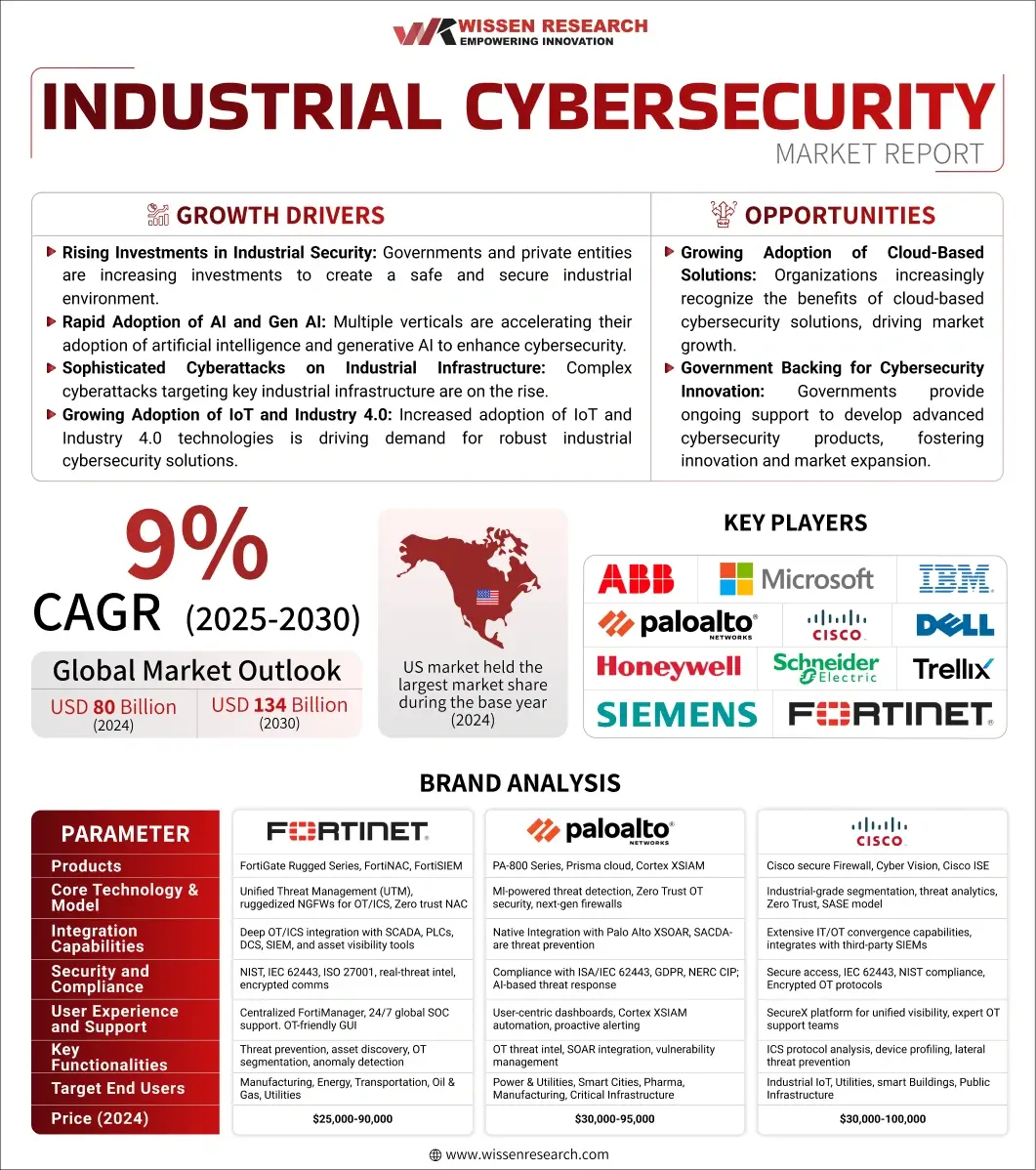
Wissen Research analysed that the global industrial cybersecurity market was valued at USD 80 billion in 2024 and is projected to reach USD 134 billion by 2030, expected to grow at a CAGR of 9% during the forecast period, 2025-2030.
Global Industrial Cybersecurity market is anticipated to reach USD 134 billion by 2030 from USD 80 billion in 2024, growing at an annualized rate of 9% during the period, 2025-2030 | North America and Europe are significant markets for Industrial Cybersecurity, driven by stringent regulations, high awareness of cybersecurity risks, and significant investments in securing industrial control systems, with key players focusing on innovation and strategic partnerships to enhance their market presence. | Asia-Pacific The Asia-Pacific Industrial Cybersecurity market is driven by rapid industrialization and increasing adoption of IIoT technologies in countries like China, Japan, and South Korea, with a focus on securing critical infrastructure, manufacturing facilities, and supply chains from growing cyber threats. |
The Industrial Cybersecurity market is driven by increasing adoption of Industry 4.0 and IIoT technologies, which exposes industrial control systems to cyber threats, necessitating robust security solutions to protect critical infrastructure and ensure operational continuity. | Convergence of IT and OT networks is a key trend in Industrial Cybersecurity, requiring security solutions that can manage the unique challenges of industrial environments while ensuring seamless integration with enterprise IT systems, with advanced threat detection, incident response, and security analytics gaining prominence. Major challenges include legacy system vulnerabilities, lack of standardization, and skilled workforce shortages, which can hinder effective cybersecurity implementation in industrial settings. |
Drivers: Ensuring Industrial Infrastructure in the Interconnected World
Notable drivers of the Industrial Cybersecurity market are growing adoption of Industry 4.0 and IIoT technologies, making industrial control systems vulnerable to cyber-attacks and creating the need for resilient security solutions to secure critical infrastructure and enable business continuity. Growing cases of cyber-attacks on industrial targets and increasing recognition of cybersecurity threats are driving investments in Industrial Cybersecurity solutions.
Opportunities: Increasing Need for OT Security and IT and OT Convergence
Merging of IT and OT networks is providing Industrial Cybersecurity solutions with scope to address one-of-a-kind industrial environment challenges while providing transparent integration with enterprise IT infrastructures. Increased use of cloud-based security solutions, sophisticated threat detection, and predictive analytics is empowering enterprises to strengthen their cybersecurity stance and react to new threats. Greater emphasis on legacy system security and supply chain security is also fueling demand for Industrial Cybersecurity solutions.
Challenges: Legacy System Vulnerabilities and Skilled Workforce Shortages
Vulnerabilities of legacy systems, unstandardization, and inadequate skilled manpower availability are key obstacles in the Industrial Cybersecurity market. Complexity of security solution integration with current OT infrastructure and ensuring compatibility with industrial standards and protocols may obstruct effective implementation of cybersecurity. Differences in regional regulations and standards, and lack of awareness of Industrial Cybersecurity threats in certain industries, also create impediments to market growth and adoption.
The global Industrial Cybersecurity market, focused on protecting industrial control systems and critical infrastructure from cyber threats, is experiencing rapid growth as industries increasingly adopt automation and IIoT technologies. Valued at USD 80 billion in 2024, the market is projected to reach USD 134 billion by 2030, growing at a CAGR of 9%. Key drivers include rising incidents of cyber-attacks on industrial targets, growing awareness of cybersecurity risks, and increasing adoption of Industry 4.0 and smart manufacturing initiatives. North America and Europe are significant markets, driven by stringent regulations and high cybersecurity awareness, while Asia Pacific is emerging as a key growth region, fueled by rapid industrialization and government initiatives to boost cybersecurity. The market’s development is also influenced by advancements in threat detection, incident response, and security analytics, as well as growing demand for OT security and convergence of IT and OT networks.
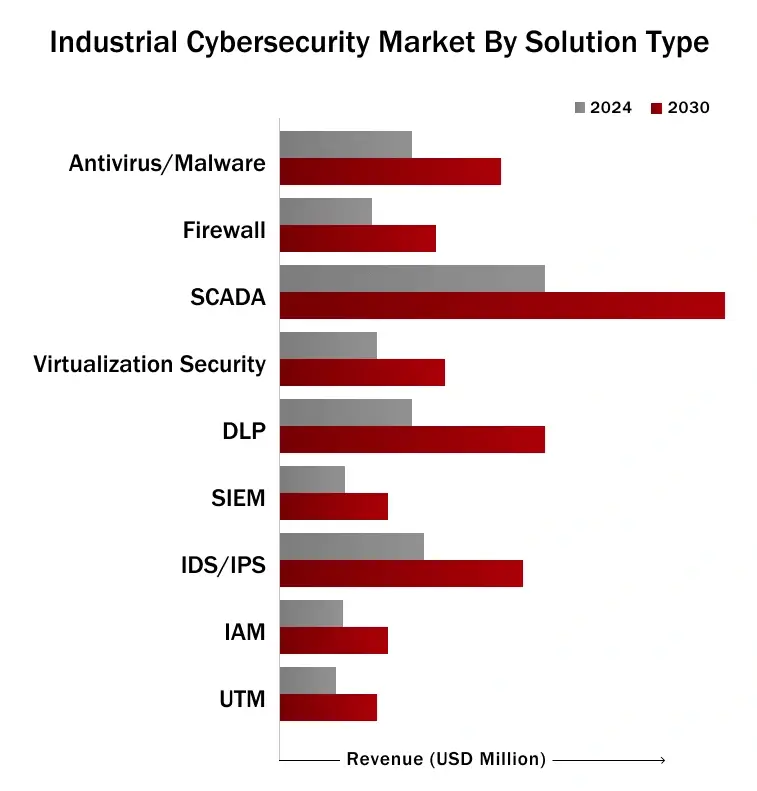
SCADA segment registered the largest market share in the industrial cybersecurity market by solution type in 2024
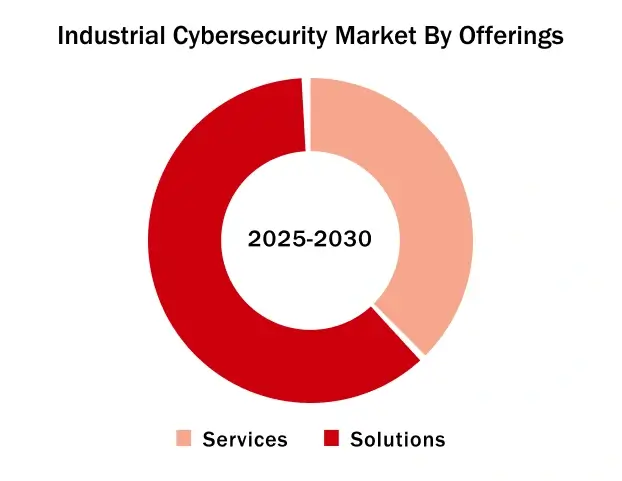
Solutions segment to witness highest growth rate in the industrial cybersecurity market by offerings in the forecast period (2025-2030).
Asia-Pacific projected to hold the largest growth rate in industrial cybersecurity market in the forecast period (2025-2030)
The Asia-Pacific region is anticipated to witness high growth in the industrial cybersecurity market due to high-speed digitalization, government policies, and increasing awareness of cybersecurity value. China, Japan, and India are enforcing strong cybersecurity regulations and spending on cybersecurity infrastructure, fueling the market growth. As industrial adoption of Industry 4.0 technologies and IoT devices continues to grow, organizations across the region are spending on high-quality industrial cybersecurity solutions to guard against emerging cyber threats, and the Asia-Pacific is becoming a growth hub of high significance for the industrial cybersecurity market.
For instance, China’s Cybersecurity Law mandates that firms deploy strong cybersecurity protocols to safeguard vital infrastructure and sensitive information, fueling demand for industrial cybersecurity solutions.
Major players operating in industrial cybersecurity market are:
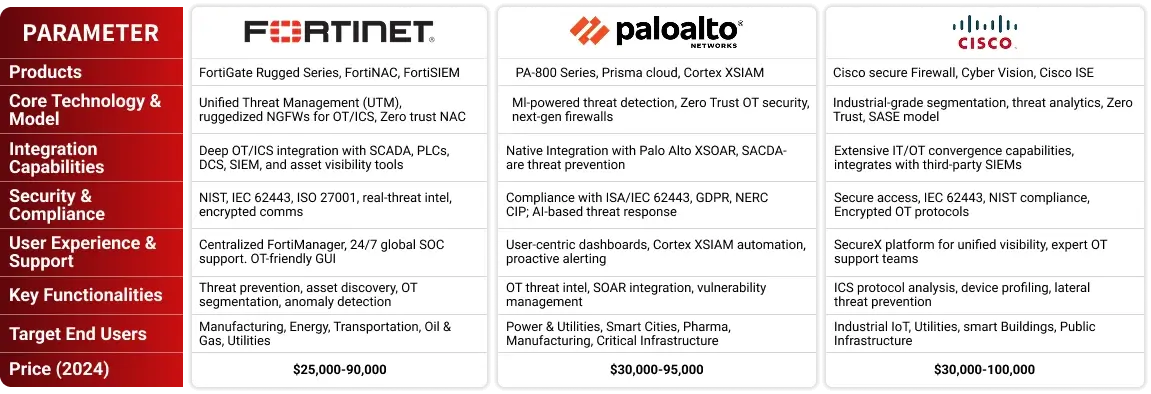
Note: Above pricing are collected from website and third party sellers.
Sources: Secondary Research
INDUSTRY SPEAK: KEY INSIGHTS FROM PRIMARY INTERVIEWS
The rising incidence of cyberattacks and threats against critical infrastructures is driving the demand for industrial cybersecurity solutions, particularly in industries such as manufacturing, energy, and transportation.”
Senior Executive – Leading Industrial Cybersecurity Firm (North America)
“Advanced technologies like artificial intelligence and machine learning are being integrated into cybersecurity solutions to enhance threat detection capabilities and automate response mechanisms.”
Cybersecurity Expert – Top Research Institution (Europe)
“Companies are recognizing that the cost of a cyberattack far exceeds the cost of prevention, leading to increased investments in advanced cybersecurity solutions.”
Industrial Cybersecurity Consultant – Global Advisory Firm (Asia-Pacific)
“Stringent regulatory and compliance requirements are compelling organizations to prioritize cybersecurity measures, particularly in critical sectors like energy and utilities.”
Risk Management Specialist – Major Industrial Company (North America)
Sources: Primary Research and Wissen Research Analysis.
Note: Above mention is non-exhaustive samples of the primary insights.
Particulars | Details |
Report | Industrial Cybersecurity Market |
Forecast Period | 2025-2030 |
Base Year | 2024 |
Format | |
Market Size (2024) | USD 80 Billion |
CAGR (2025-2030) | 9% |
Number of Pages | 160 |
Number of Tables | 155 |
Number of Figures | 35 |
Key Segments | Industrial Cybersecurity Market by Deployment Mode (On-Premise, Cloud-Based, Hybrid) Industrial Cybersecurity Market by Security Type (Network Security, Endpoint Security, Application Security, Cloud Security, Wireless Security) Industrial Cybersecurity Market by Offerings (Solutions, Services) Industrial Cybersecurity Market by Solution Type (Antivirus/Malware, Firewall, SCADA (Supervisory Control and Data Acquisition), Virtualization Security, DLP (Data Loss Prevention), SIEM (Security Information and Event Management), IDS/IPS (Intrusion Detection System/ Intrusion Prevention System), IAM (Identity and Access Management), UTM (Unified Threat Management), DDOS (Distributed Denial of Service), Other Solution Types) Other Solution Types includes Compliance and Policy Management, Encryption and Tokenization, Update and Patch Management, Database Activity Monitoring Industrial Cybersecurity Market by End User Industry (Healthcare & Life Sciences, Aerospace & Defence, Manufacturing, Energy & Utilities, Telecommunications, Other End User Industry) Other End User Industry includes Construction, Real Estate |
Regions Covered | § North America: US and Canada § Europe: Germany, UK, France, Italy, Spain, and Rest of the Europe § Asia-Pacific: China, Japan, India, South Korea, Australia and New Zealand, and Rest of the Asia-Pacific § Latin America § Middle East and Africa |
Key Players Covered (Majority Share Holders) | ABB Ltd. (Switzerland), Microsoft Corporation (US), International Business Machines Corporation (IBM) (US), Palo Alto Networks Inc. (US), Fortinet Inc. (US), Cisco Systems Inc. (US), Honeywell International Inc. (US), Schneider Electric SE (France), Musarubra US LLC (US), Siemens AG (Germany), Dell Inc. (US) |
Other Players | Gen Digital Inc. (US), Rockwell Automation Inc. (US), AO Kaspersky Lab (Russia), Proofpoint, Inc. (US), Trend Micro Incorporated (Japan), Broadcom (US), Forescout (US), Opswat Inc. (US), Dragos Inc. (US), Cyberark Software Ltd. (Israel), Plaxidityx Ltd. (Israel), Cylus Ltd. (Israel), Upstream Security Ltd. (Israel), Proficio (Ireland), Netskope, Inc. (US), Onapsis (US) |
1. INTRODUCTION
1.1. KEY OBJECTIVES
1.2. DEFINITIONS
1.2.1. IN SCOPE
1.2.2. OUT OF SCOPE
1.3. SCOPE OF THE REPORT
1.4. SCOPE RELATED LIMITATIONS
1.5. KEY STAKEHOLDERS
2. RESEARCH METHODOLOGY
2.1. RESEARCH APPROACH
2.2. RESEARCH METHODOLOGY / DESIGN
2.3. MARKET SIZE ESTIMATION APPROACHES
2.3.1. SECONDARY RESEARCH
2.3.2. PRIMARY RESEARCH
2.3.2.1. KEY INSIGHTS FROM INDUSTRY EXPERTS
2.4. DATA VALIDATION & TRIANGULATION
2.5. ASSUMPTIONS OF THE STUDY
3. EXECUTIVE SUMMARY & PREMIUM CONTENT
3.1. GLOBAL MARKET OUTLOOK
3.2. KEY MARKET FINDINGS
4. MARKET OVERVIEW
4.1. INDUSTRIAL CYBERSECURITY: OVERVIEW
4.1.1. INTRODUCTION
4.1.2.KEY FEATURES AND FUNCTIONALITIES
4.1.3.BENEFITS OF INDUSTRIAL CYBERSECURITY
4.1.4.TYPES OF INDUSTRIAL CYBERSECURITY
4.2. MARKET DYNAMICS
4.2.1. MARKET DRIVERS
4.2.2. MARKET OPPORTUNITIES
4.2.3. RESTRAINTS/CHALLENGES
4.3. END USER PERCEPTION
4.4. NEED GAP ANALYSIS
4.5. SUPPLY CHAIN / VALUE CHAIN ANALYSIS
4.6. INDUSTRY TRENDS
4.7. PORTER’S FIVE FORCES ANALYSIS
4.8. REGULATORY LANDSCAPE
4.8.1.NORTH AMERICA
4.8.2.EUROPE
4.8.3.ASIA PACIFIC
5. PATENT ANALYSIS
5.1. TOP ASSIGNEES
5.2. GEOGRAPHY FOCUS OF TOP ASSIGNEES
5.3. LEGAL STATUS
5.4. TECHNOLOGY EVOLUTION
5.5. KEY PATENTS
5.6. PATENT TRENDS AND INNOVATIONS
6. GLOBAL INDUSTRIAL CYBERSECURITY MARKET, BY DEPLOYMENT MODE (2024-2030, USD MILLION)
6.1. ON-PREMISE
6.2. CLOUD-BASED
6.3. HYBRID
7. GLOBAL INDUSTRIAL CYBERSECURITY MARKET, BY SECURITY TYPE (2024-2030, USD MILLION)
7.1. NETWORK SECURITY
7.2. ENDPOINT SECURITY
7.3. APPLICATION SECURITY
7.4. CLOUD SECURITY
7.5. WIRELESS SECURITY
7.6. OTHER SECURITY TYPES
8. GLOBAL INDUSTRIAL CYBERSECURITY MARKET, BY SOLUTION TYPE (2024-2030, USD MILLION)
8.1. ANTIVIRUS/MALWARE
8.2. FIREWALL
8.2.1.PROXY FIREWALL
8.2.2.PACKET-FILTERING FIREWALL
8.2.3.STATEFUL INSPECTION FIREWALL
8.2.4.NEXT-GENERATION FIREWALL
8.3. SCADA (SUPERVISORY CONTROL AND DATA ACQUISITION)
8.4. VIRTUALIZATION SECURITY
8.5. DLP (DATA LOSS PREVENTION)
8.6. SIEM (SECURITY INFORMATION AND EVENT MANAGEMENT)
8.7. IDS/IPS (INTRUSION DETECTION SYSTEM/ INTRUSION PREVENTION SYSTEM)
8.8. IAM (IDENTITY AND ACCESS MANAGEMENT)
8.9. UTM (UNIFIED THREAT MANAGEMENT)
8.10. DDOS (DISTRIBUTED DENIAL OF SERVICE)
8.11. OTHER SOLUTION TYPES
8.11.1. COMPLIANCE AND POLICY MANAGEMENT
8.11.2. ENCRYPTION AND TOKENIZATION
8.11.3. UPDATE AND PATCH MANAGEMENT
8.11.4. DATABASE ACTIVITY MONITORING
9. GLOBAL INDUSTRIAL CYBERSECURITY MARKET, BY OFFERING (2024-2030, USD MILLION)
9.1. SOLUTIONS
9.1.1.HARDWARE
9.1.1.1. GATEWAYS
9.1.1.2. NETWORKING DEVICES
9.1.1.3. HARDWARE SECURITY MODULES
9.1.1.4. ENCRYPTION STORAGE DEVICES
9.1.1.5. NETWORK ENCRYPTION APPLIANCES
9.1.1.6. SECURE USB DRIVES
9.1.1.7. HARDWARE TOKENS
9.1.1.8. NETWORK ACCESS CONTROL DEVICES
9.1.1.9. HARDWARE FIREWALL
9.1.2.SOFTWARE
9.2. SERVICES
9.2.1.MANAGED SERVICES
9.2.2.PROFESSIONAL SERVICES
10. GLOBAL INDUSTRIAL CYBERSECURITY MARKET, BY END USER INDUSTRY (2024-2030, USD MILLION)
10.1. HEALTHCARE & LIFE SCIENCES
10.2. AEROSPACE & DEFENSE
10.3. MANUFACTURING
10.3.1. AUTOMOTIVE
10.3.2. MACHINE MANUFACTURING
10.3.3. SEMICONDUCTOR & ELECTRONICS
10.3.4. MEDICAL DEVICES
10.3.5. OTHER MANUFACTURING INDUSTRIES
10.4. ENERGY & UTILITIES
10.4.1. POWER GENERATION PLANTS
10.4.1.1. NUCLEAR POWER PLANTS
10.4.1.2. THERMAL AND HYDROPOWER PLANTS
10.4.1.3. RENEWABLE ENERGY POWER PLANTS
10.4.2. POWER GRIDS
10.4.3. OIL & GAS PIPELINES
10.4.4. ELECTRIC POWER TRANSMISSION
10.4.5. WATER TREATMENT AND DISTRIBUTION
10.4.6. WASTEWATER COLLECTION AND TREATMENT
10.5. TELECOMMUNICATIONS
10.6. OTHER END USER INDUSTRIES
10.6.1. CONSTRUCTION
10.6.2. REAL ESTATE
11. GLOBAL INDUSTRIAL CYBERSECURITY MARKET, BY REGION (2024-2030, USD MILLION)
11.1. NORTH AMERICA
11.1.1. US
11.1.2. CANADA
11.2. EUROPE
11.2.1. GERMANY
11.2.2. FRANCE
11.2.3. SPAIN
11.2.4. ITALY
11.2.5. UK
11.2.6. REST OF THE EUROPE
11.3. ASIA-PACIFIC
11.3.1. CHINA
11.3.2. JAPAN
11.3.3. INDIA
11.3.4. AUSTRALIA AND NEW ZEALAND
11.3.5. SOUTH KOREA
11.3.6. REST OF THE ASIA-PACIFIC
11.4. MIDDLE EAST AND AFRICA
11.5. LATIN AMERICA
12. COMPETITIVE ANALYSIS
12.1. PRODUCT PIPELINE: INDUSTRIAL CYBERSECURTIY
12.2. KEY PLAYERS FOOTPRINT ANALYSIS
12.3. MARKET SHARE ANALYSIS (2023/2024)
12.4. REGIONAL SNAPSHOT OF KEY PLAYERS
12.5. R&D EXPENDITURE OF KEY PLAYERS
13. COMPANY PROFILES
13.1. ABB LTD. (Switzerland)
13.1.1. BUSINESS OVERVIEW
13.1.2. PRODUCT PORTFOLIO
13.1.3. FINANCIAL SNAPSHOT
13.1.4. RECENT DEVELOPMENTS
13.1.4.1. MERGER/ACQUISITIONS
13.1.4.2. PRODUCT APPROVAL/LAUNCHES
13.1.4.3. PARTNERSHIP/COLLABORATIONS/AGREEMENTS
13.1.4.4. EXPANSIONS
13.2. MICROSOFT CORPORATION (US)
13.3. INTERNATIONAL BUSINESS MACHINES CORPORATION (IBM) (US)
13.4. PALO ALTO NETWORKS INC. (US)
13.5. FORTINET INC. (US)
13.6. CISCO SYSTEMS INC. (US)
13.7. HONEYWELL INTERNATIONAL INC. (US)
13.8. SCHNEIDER ELECTRIC SE (FRANCE)
13.9. MUSARUBRA US LLC (US)
13.10. SIEMENS AG (GERMANY)
13.11. DELL INC. (US)
13.12. OTHER PLAYERS
13.12.1. GEN DIGITAL INC. (US)
13.12.2. ROCKWELL AUTOMATION INC. (US)
13.12.3. AO KASPERSKY LAB (RUSSIA)
13.12.4. PROOFPOINT, INC. (US)
13.12.5. TREND MICRO INCORPORATED (JAPAN)
13.12.6. BROADCOM (US)
13.12.7. FORESCOUT (US)
13.12.8. OPSWAT INC. (US)
13.12.9. DRAGOS INC. (US)
13.12.10. CYBERARK SOFTWARE LTD. (ISRAEL)
13.12.11. PLAXIDITYX LTD. (ISRAEL)
13.12.12. CYLUS LTD. (ISRAEL)
13.12.13. UPSTREAM SECURITY LTD. (ISRAEL)
13.12.14. PROFICIO (IRELAND)
13.12.15. NETSKOPE, INC. (US)
13.12.16. ONAPSIS (US)
14. APPENDIX
14.1. INDUSTRY SPEAK
14.2. QUESTIONNAIRE/DISCUSSION GUIDE
14.3. AVAILABLE CUSTOM WORK
14.4. ADJACENT STUDIES
14.5. AUTHORS
15. REFERENCES
The industrial cybersecurity market covers a wide variety of solutions and services aimed at safeguarding industrial control systems (ICS), operational technology (OT), and critical infrastructure against cyber-attacks. These solutions protect industries like oil and gas, power generation and transmission, water treatment, chemicals, pharmaceuticals, automotive manufacturing, and other industrial businesses from unauthorized access, data theft, and operations disruption. The offerings comprise network security, endpoint security, application security, and data security, along with services such as risk assessments, penetration testing, incident response, and security consulting. Industrial cybersecurity solutions are offered across different models of deployment, including on-premises, cloud-based, and hybrid, and aim to provide industrial operation availability, reliability, and safety. The market is fueled by growing convergence of IT and OT systems, heightened awareness of cybersecurity threats, compliance with regulatory needs, and the increasing adoption of Industry 4.0 and smart manufacturing programs. Emerging technologies such as artificial intelligence, machine learning, and the Industrial Internet of Things (IIoT) are further influencing the market’s growth and development.
FIGURE: INDUSTRIAL CYBERSECURITY MARKET SEGMENTS
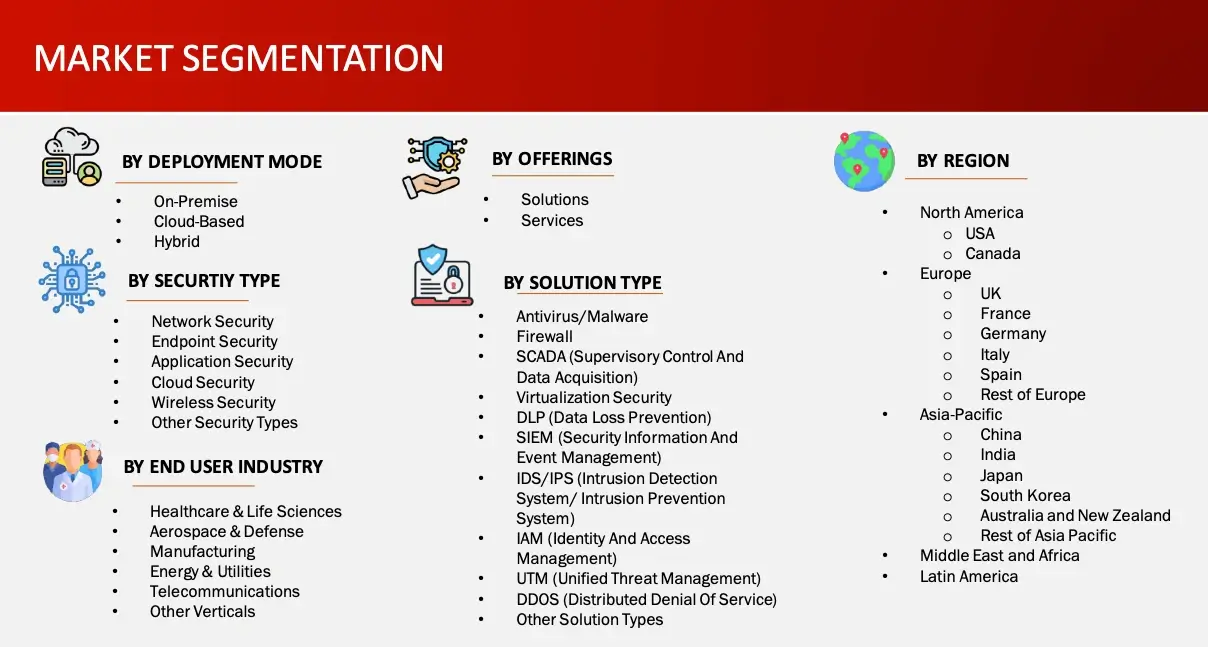
Sources: Company Websites and Wissen Research Analysis
Key Stakeholders
Key Study Objectives
Research Methodology
The objective of the study is to analyze the key market dynamics such as drivers, opportunities, challenges, restraints, and key player strategies. To track company developments such as product launches and approvals, expansions, and collaborations of the leading players, the competitive landscape of the industrial cybersecurity market to analyze market players on various parameters within the broad categories of business and product strategy. Top-down and bottom-up approaches will be used to estimate the market size. To estimate the market size of segments and sub segments the market breakdown and data triangulation will be used.
FIGURE: RESEARCH DESIGN
Sources: Wissen Research Analysis
Research Approach
Collecting Secondary Data
The secondary research data collection process involves the usage of secondary sources, directories, databases, annual reports, investor presentations, and SEC filings of companies. Secondary research will be used to identify and collect information useful for the extensive, technical, market-oriented, and commercial study of the industrial cybersecurity market. A database of the key industry leaders will also be prepared using secondary research.
Collecting Primary Data
The primary research data will be conducted after acquiring knowledge about the industrial cybersecurity market scenario through secondary research. A significant number of primary interviews will be conducted with stakeholders from both the demand side and supply side (including various industry experts, such as Directors, Chief X Officers (CXOs), Vice Presidents (VPs) from business development, marketing and product development teams, product manufacturers) across major countries of North America, Europe, Asia Pacific, and Rest of the World. Primary data for this report was collected through questionnaires, emails, and telephonic interviews.
Market Size Estimation
All major developers offering various industrial cybersecurity will be identified at the global/regional level. Revenue mapping will be done for the major players, which will further be extrapolated to arrive at the global market value of each type of segment. The market value of industrial cybersecurity market will also split into various segments and sub segments at the region level based on:
Research Design
After arriving at the overall market size using the market size estimation processes-the market will be split into several segments and sub segment. To complete the overall market engineering process and arrive at the exact statistics of each market segment and sub segment, the data triangulation, and market breakdown procedures will be employed, wherever applicable. The data will be triangulated by studying various factors and trends from both the demand and supply sides in the industrial cybersecurity industry.